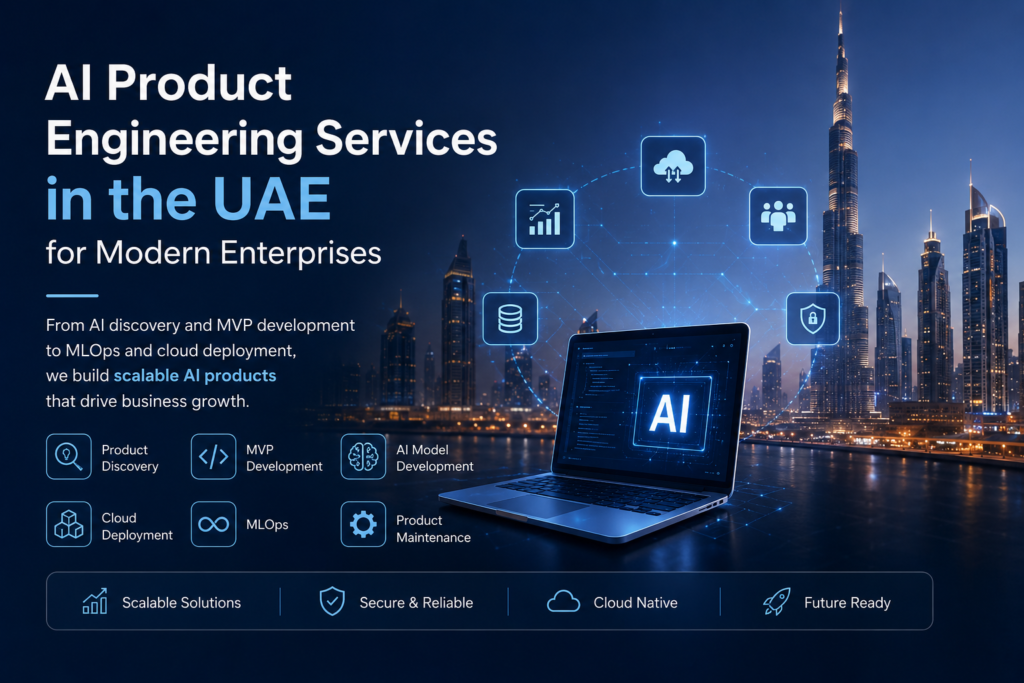
AI Product Engineering Services in the UAE
AI product engineering services are becoming increasingly important for businesses in the UAE looking to design, develop, and scale intelligent software products. From automating business processes to improving customer experiences, AI can help organizations achieve a wide range of operational and strategic goals.
However, building an AI product involves much more than developing an AI model. Product strategy, software engineering, data, cloud infrastructure, testing, deployment, security, and ongoing maintenance all play an important role.
AI Product Engineering: What It Is and Why It Matters
AI product engineering refers to the design, development, and maintenance of software products that use artificial intelligence. Unlike traditional software development, AI products require additional considerations such as AI and machine learning development, data engineering, model deployment, monitoring, and MLOps.
Key Components of AI Product Engineering
- Product discovery and strategy
- UX and product design
- Software engineering
- AI and machine learning development
- Data engineering
- Cloud infrastructure
- Model deployment and monitoring
- MLOps
- Product testing and maintenance
Why Are Companies in the UAE Investing in AI Products?
Businesses across the UAE are adopting AI to automate processes, improve customer experiences, analyze data, support employees, streamline operations, and make better business decisions.
Common AI Applications for Businesses
- AI customer support
- Document processing
- Predictive analytics
- Recommendation systems
- Generative AI
- Computer vision
- AI SaaS products
- Intelligent automation
- Fraud detection
AI Product Engineering Services for Businesses in the UAE
An experienced AI product engineering partner can help organizations throughout the complete product development lifecycle.
1. Product Discovery
The product discovery phase focuses on understanding the business problem, target users, potential AI use cases, technical feasibility, competitors, and the overall product roadmap.
Key Activities
- Business and user research
- AI use-case identification
- Technical feasibility analysis
- Competitor research
- Roadmapping
- MVP planning
- Technology selection
2. MVP Development
An MVP, or minimum viable product, includes the essential features required to test a product concept and collect feedback from real users before investing in a larger-scale solution.
3. Product Architecture
A scalable architecture is designed to support the application’s software components, AI systems, data flows, integrations, security requirements, and infrastructure.
4. AI Development and Integration
AI models, APIs, retrieval systems, machine learning pipelines, and other intelligent components are developed and integrated into the product.
5. Testing and Evaluation
AI products need to be evaluated for usability, functionality, security, performance, reliability, and AI quality before production deployment.
6. Cloud Deployment
Once the product is validated, it can be deployed using production-ready cloud infrastructure, monitoring, security, and deployment processes.
7. Optimize and Scale
After launch, continuous optimization helps improve product performance, AI capabilities, infrastructure, features, and the overall user experience.
Technologies Used for AI Product Engineering
AI and Machine Learning
Python, PyTorch, TensorFlow, Scikit-learn, Generative AI, large language models, natural language processing, and computer vision.
Backend Development
Python, Node.js, REST APIs, GraphQL, microservices, and serverless architectures.
Frontend Development
React, Next.js, TypeScript, and modern web application frameworks.
Data Technologies
PostgreSQL, MongoDB, Redis, vector databases, data warehouses, and data processing pipelines.
Cloud and Infrastructure
AWS, Microsoft Azure, Google Cloud, Docker, Kubernetes, and CI/CD infrastructure.
MLOps and Monitoring
Model versioning, model monitoring, experiment tracking, automated deployment, AI evaluation, and application observability.
Industries We Build AI Products For
Healthcare
AI can support healthcare administration, documentation, patient engagement, analytics, and intelligent workflows.
Financial Services
AI can help with fraud detection, risk analysis, customer service, financial analytics, document processing, and workflow automation.
Retail and E-commerce
Businesses can use AI for recommendations, personalization, demand forecasting, inventory optimization, and customer service.
Logistics and Transportation
AI can support demand forecasting, route optimization, workflow automation, fleet operations, and operational efficiency.
Manufacturing
AI can be used for predictive maintenance, quality inspection, production optimization, and intelligent automation.
Real Estate
AI can support property recommendations, document analysis, customer engagement, lead management, and market analytics.
SaaS and Technology
SaaS and technology companies can use AI to develop innovative products, intelligent platforms, and automated business solutions.
Why Choose AxioraLabs AI?
End-to-End AI Product Development
We support organizations from product discovery and MVP development through deployment, optimization, and ongoing maintenance.
Business-Centric Approach
Our approach focuses on solving real business problems rather than simply adopting the latest technology.
Scalable Architecture
We design AI products with future growth, performance, reliability, and scalability in mind.
Production-Ready Engineering
AI products are developed with the engineering practices required for reliable production environments.
Flexible Technology Approach
We select technologies based on the specific business, technical, security, and scalability requirements of each product.
Frequently Asked Questions About AI Product Engineering Services in the UAE
How Much Does AI Product Engineering Cost in the UAE?
The cost of AI Product Engineering depends on factors such as product complexity, data requirements, infrastructure, integrations, security needs, and development team size. Enterprise-level products generally require a larger investment than MVPs.
How Long Does It Take to Build an AI Product?
The timeline depends on the complexity of the solution, data requirements, integrations, and development team. An MVP may take several months, while a full-scale product can require additional development time.
Should We Build an AI Model From Scratch?
Not always. Existing foundation models and APIs can often be used. Custom models may be appropriate when greater accuracy, performance, control, or data privacy is required.
Can You Integrate AI Into an Existing Software Product?
Yes. AI can be integrated into existing software products to enhance functionality, automate processes, improve decision-making, and create better user experiences.
What Is the Difference Between AI Development and AI Product Engineering?
AI development generally focuses on building AI models, while AI product engineering covers the broader product lifecycle, including strategy, software development, AI integration, deployment, testing, monitoring, and maintenance.
Why Is MLOps Important for AI Products?
MLOps helps organizations operationalize and maintain machine learning models through monitoring, versioning, deployment, evaluation, and ongoing optimization.
Build Your AI Product With an Experienced Engineering Partner
Building a successful AI product requires more than an AI model. It requires strong product strategy, engineering, data, infrastructure, testing, security, and continuous optimization.
AxioraLabs AI helps businesses in the UAE turn AI ideas into scalable, production-ready products designed around real business requirements.