Custom AI Solutions in the USA
Artificial intelligence is quickly becoming a practical tool for businesses across the United States. By applying AI to day-to-day operations, companies can improve customer experience, automate repetitive processes, and unlock new digital opportunities.
But what many organisations soon learn is that out-of-the-box tools are often ill-suited to their operations. A generic chatbot may know little about a company’s internal processes. An analytical tool may poorly represent an organisation’s data. An automation utility may lack the flexibility or security to be useful. And a commercial AI product may not provide the control or customization an enterprise needs.
This is why Custom AI Solutions can often be more valuable: they are designed to meet the needs of an organisation, instead of the other way around.
At Axiora Labs AI we can help businesses across the USA to design and develop bespoke AI solutions to meet specific business needs, incorporate existing software, and achieve measurable outcomes.
What Are Custom AI Solutions?
Custom AI Solutions are artificial intelligence systems that are designed to meet the specific needs of an organisation. Unlike commercial software, custom applications can be built around business processes, data, users, systems, and more.
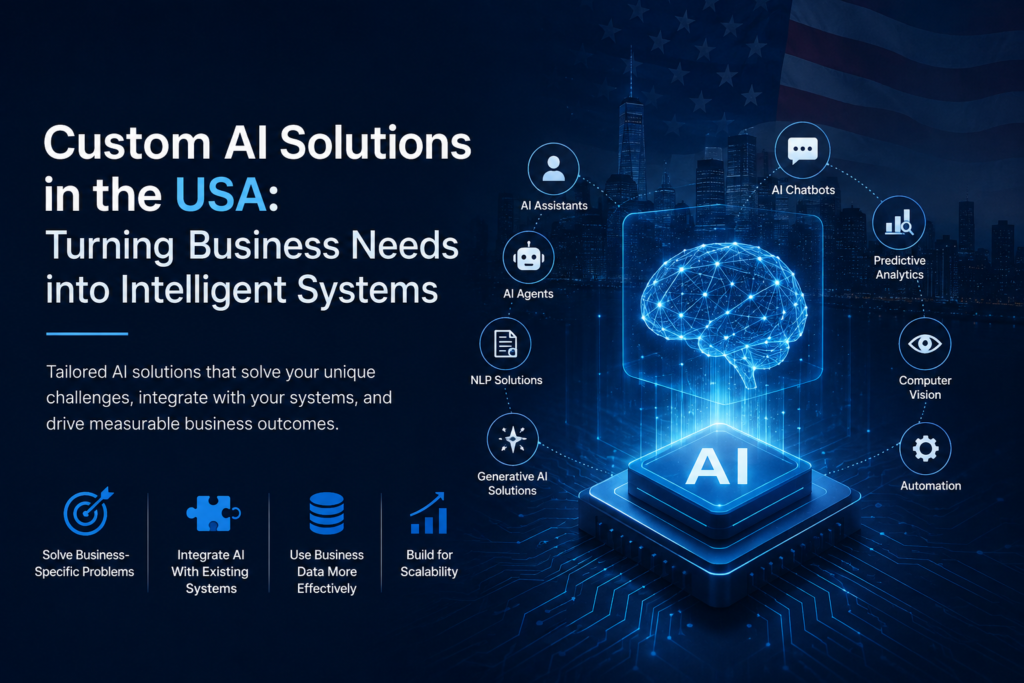
Custom AI Solutions can take many forms, including:
- AI chatbots
- AI assistants
- AI agents
- Predictive analytics
- Recommendation systems
- Computer vision systems
- Natural language processing (NLP)
- Generative AI applications
- Intelligent workflow automation
- Knowledge systems
- AI business applications
These solutions can utilise existing AI models, machine learning algorithms, data sets, APIs, business rules, or other technologies to meet specific requirements. The focus is on building an AI application that directly addresses a business need.
Why US Businesses Are Investing in Custom AI Solutions
Organisations across the United States have unique business processes, systems, procedures, and data requirements. For many companies, off-the-shelf AI tools are often insufficient for their needs. This is why many US-based businesses are beginning to invest in custom AI development.
Solve Specific Business Problems
Many businesses have unique workflows and requirements that generic systems are not designed to handle.
A company may need an AI assistant to search its internal systems and provide answers to employees. Another business may need an intelligent agent to connect a CRM, support desk, and internal database to perform specific tasks. Some organisations may need computer vision systems to inspect products on a production line, while others may benefit from an AI-driven analytics platform to forecast sales. By utilising Custom AI Solutions, businesses can design intelligence systems around their specific requirements.
Integrate AI Into Their Technology Ecosystem
Most businesses do not operate with a single software application. Instead, companies often have a variety of systems that must work together to perform their daily operations. This may include a CRM, ERP, customer support desk, databases, cloud applications, document management systems, analytics tools, messaging platforms, and other software. By designing a custom AI solution, businesses can ensure that the application integrates into their broader technology ecosystem and automates workflows effectively.
Leverage Data Specific to Their Organisation
Another advantage of custom AI solutions is the ability to incorporate and utilise data specific to an organisation. This could include customer data, product data, internal documents, employee records, financial transactions, support tickets, sales figures, supply chain information, or other data sets. Well-designed AI applications can help businesses to make sense of this information and realise its value.
Design AI Applications Around Their Users
Not all companies have the same users, and different roles within an organisation may require different levels of access and functionality. By developing a custom AI application, businesses can design an interface and features around their specific users and their requirements. This can be critical for enterprises with complex digital ecosystems that need to streamline access and operations.
Scale AI Solutions as Their Business Grows
Many businesses start small, utilising AI to address a specific pain point. But as companies grow and operations become more complex, the need for scaled solutions increases. Custom AI applications offer the flexibility to support expanding operations, additional users, and more features. This can be vital for enterprises looking to maximise the value of their AI applications.
What Types of Custom AI Solutions Can Businesses Develop?
The type of Custom AI Solution that an organisation should build depends on their requirements. Some common use cases include:
AI Chatbots
Custom AI chatbots can be valuable for organisations that want to deliver conversational support to customers, employees, or business partners. These solutions can be utilised in a variety of ways, including:
- Customer service
- Product support
- Internal IT support
- Human resources operations
- Appointment scheduling
- Knowledge base queries
- Lead qualification
Unlike generic chatbots, custom solutions can be built around internal processes, data, and systems.
AI Assistants
AI assistants can help businesses to optimise employee productivity and support. These solutions can be trained to perform a variety of tasks, including:
- Searching internal information
- Summarising documents
- Preparing reports
- Generating responses
- Analysing business data
- Creating content
- Retrieving information
- Supporting decision-making
Custom assistants can be valuable across many industries, including finance, healthcare, legal services, manufacturing, logistics, and more.
AI Agents
AI agents can offer businesses advanced automation capabilities, often performing beyond the ability of traditional chatbots or assistants. Agents can be trained to execute certain processes across a variety of systems, including:
- Reviewing customer data
- Searching a database
- Updating a CRM
- Generating responses
- Creating tasks
- Notifying employees
Many companies benefit from intelligent agents that can help to streamline and automate their operations.
Predictive Analytics
Predictive analytics utilise historical data to forecast future trends and events. This type of AI solution can be valuable in a variety of industries, supporting businesses with:
- Demand planning
- Customer acquisition
- Sales forecasting
- Risk management
- Inventory optimisation
- Maintenance scheduling
- Operational planning
Custom predictive analytics solutions can be built around specific use cases and datasets within an organisation.
Recommendation Systems
Recommendation systems employ AI to suggest products, services, or actions to users. This type of solution is often used in e-commerce, content platforms, and other industries that want to improve customer engagement and sales. Custom recommendation systems can help organisations to:
- Deliver targeted marketing
- Improve sales operations
- Recommend pertinent content
- Personalise customer experiences
Computer Vision Solutions
Computer vision solutions utilise AI to interpret and analyse images and video. These systems can be valuable in a variety of industries, including manufacturing, healthcare, logistics, and more. Potential applications include:
- Quality control
- Object identification
- Document recognition
- Asset inspection
- Visual monitoring
- Image analysis
Custom computer vision solutions can be designed for specific use cases and environments.
Natural Language Processing (NLP)
NLP allows computers to understand, interpret, and respond to human languages. This AI technology can be valuable for organisations that want to extract meaning from large amounts of text, including:
- Document classification
- Information extraction
- Customer communication analysis
- Contract analysis
- Sentiment analysis
- Enterprise search
NLP can be incorporated into many types of business software to improve its functionality.
Generative AI Solutions
Generative AI solutions can be valuable for businesses that want to create, generate, transform, and utilise information. These solutions can be used for:
- Enterprise knowledge access
- Document summarisation
- Research assistance
- Content generation
- Customer communication
- Internal copilots
- Data analysis
Custom generative AI solutions can be valuable across many industries, including healthcare, finance, manufacturing, logistics, legal services, and more.
AI Workflow Automation
Businesses can also leverage AI to automate specific tasks and processes. Depending on a company’s requirements, AI-driven automation can assist with:
- Document processing
- Data extraction
- Request categorisation
- Approval routing
- Customer support
- Finance operations
- Sales processes
- Internal reporting
Many companies utilise AI automation to improve efficiency and reduce the need for manual processes.
Our Approach to Custom AI Development
At Axiora Labs AI our custom AI development process begins with understanding your requirements and addressing a specific business need. We follow these steps to build your solution:
1. Business Discovery
We begin by understanding your requirements and objectives. This may include:
- Your business goals
- Operational processes
- User requirements
- System requirements
- Data requirements
- Expected outcomes
This helps us to fully comprehend your requirements and identify how we can apply AI to deliver value.
2. Use Case Definition
Next, we work to define your business use case. This involves exploring:
- Your users
- Required functionality
- Desired outputs
- Business rules
- Success metrics
- Integration requirements
- Security requirements
- Other factors
This helps us to ensure we develop a solution that will meet your needs.
3. Solution Architecture
With your requirements defined, we can begin designing your solution. This includes:
- AI models
- Application development requirements
- APIs
- Database requirements
- Vector database requirements
- Authentication requirements
- Business system requirements
- User interface requirements
- Infrastructure requirements
This phase ensures we can design a solution that will address your requirements and scale as needed.
4. Data and Integration Planning
Most AI applications rely on data and business systems to operate. As such, we will work to:
- Identify data requirements
- Determine data sources
- Evaluate data quality
- Determine API requirements
- Evaluate integration requirements
- Define security requirements
- Ensure data processing requirements are identified
This helps us to ensure we can design an application around your data and systems.
5. AI Development
With the architecture designed, we can begin development. This may involve building:
- AI models
- Application development
- API development
- Database development
- Vector database development
- Infrastructure development
The development process will vary depending on your requirements, but it may include:
- Large language models
- Machine learning models
- Retrieval-augmented generation
- NLP
- Computer vision
- Predictive analytics
- AI agents
- AI workflow automation
6. Testing and Validation
Before solution deployment, we conduct extensive testing and validation to ensure:
- Accuracy
- Reliability
- Security
- Performance
- Compatibility
- Usability
- Edge cases
- Business rule compliance
We will also test your solution’s outputs to ensure they meet your requirements and use-case scenario.
7. Deployment and Integration
Your solution can then be deployed and integrated into your technology ecosystem. This may involve:
- Cloud deployment
- Enterprise application integration
- API deployment
- Internal system integration
- Web application deployment
- Mobile application deployment
- Business system integration
8. Monitoring and Improvement
After deployment, your solution should be monitored to ensure it meets your requirements and performs reliably. We can also work to:
- Improve performance
- Expand functionality
- Enhance capabilities
- Increase accuracy
- Ensure user adoption
- Address technical issues
Technologies and Frameworks for Custom AI Development
Custom AI solutions can be built using a variety of technologies and frameworks, including:
Large Language Models
Large language models can be valuable for developing chatbots, assistants, search solutions, agents, and more.
Machine Learning
Machine learning can be used to develop a variety of AI applications, including recommendation systems, analytics solutions, and more.
Generative AI
Generative AI can be used to support content creation, knowledge access, and more.
Natural Language Processing
NLP enables computers to understand and respond to human languages.
Computer Vision
Computer vision can be leveraged to develop image recognition and analysis solutions.
Vector Databases and Retrieval Systems
These systems can be utilised to develop recommendation engines and knowledge systems.
Cloud AI
Cloud AI platforms can be used to develop and deploy scalable AI solutions.
APIs and Enterprise Software
APIs can be used to connect AI applications to enterprise software.
Industries That Can Benefit From Custom AI Solutions
Custom AI solutions can be valuable across a variety of industries, including:
Logistics & Supply Chain
Custom AI solutions can be utilised to support logistics operations, including shipment tracking, document processing, analytics, procurement, and more.
Manufacturing
AI can be used to support manufacturing processes, including predictive maintenance, computer vision, quality control, analytics, and automation.
Banking & Financial Services
AI solutions can be used to support banking operations, including document processing, analytics, internal assistants, customer service, and more.
Insurance
Custom AI solutions can be utilised to support insurance operations, including claims processing, policy management, document analysis, knowledge management, and customer service.
Healthcare
Healthcare companies can leverage AI to support administrative operations, document processing, scheduling, knowledge management, and more.
Pharma & Life Sciences
Pharma and life sciences companies can utilise AI to support research, document processing, knowledge management, analytics, and operations.
Enterprise IT & GCCs
Enterprises can employ AI to support internal operations, including assistant development, knowledge systems, service automation, agents, IT operations, and more.
Legal Services
AI solutions can be used to support legal operations, including document review, contract analysis, knowledge management, research, service automation, and more.
Government & Public Sector
Custom AI solutions can be utilised to support government operations, including information management, citizen services, document processing, knowledge management, and more.
Why Choose Axiora Labs AI for Custom AI Solutions in the USA?
Custom AI development is a complex process, and it is critical to choose a reliable partner that fully understands your requirements. At Axiora Labs AI we can work with you to develop a bespoke solution that addresses your needs and delivers exceptional results.
Our custom AI development process is built around business discovery, use-case definition, solution architecture, data planning, enterprise integration, AI development, testing, and deployment. This helps to ensure that we fully understand your requirements and deliver an effective solution.
Turning Business Needs Into Innovative Systems
Often, the most valuable AI solutions are not the most complex ones. In fact, many businesses find that a well-designed AI application that addresses a specific need can provide exceptional value. Most companies do not need an enterprise-wide AI transformation at the moment – they need a solution that solves a particular business problem.
An organisation may need a knowledge assistant to help its staff, an AI agent to perform specific tasks, or a predictive analytics solution to support planning. It may want to utilise a chatbot to improve its customer experience or deploy a computer vision system to inspect products. By identifying a clearly defined use case and building a solution around it, a business can begin to realise the value of artificial intelligence.
As these applications are deployed and proven to be valuable, they can become the foundation for an extended AI strategy, supporting additional solutions that address more complex needs.