AI Consulting Services in Australia
Artifi cial intelligence is becoming a strategically important priority for organisations across Australia. Businesses are looking to generative AI, machine learning, AI agents, predictive analytics, intelligent automation, and other technologies to help drive productivity, improve the customer experience, enable better decision-making, and unlock new business potential.
However, while developing an AI strategy is often a priority, businesses then face the challenge of execution – taking advantage of the opportunities presented by their strategy, delivering value, and accelerating adoption across the organisation.
It can be difficult to decide which AI opportunities should be prioritised, what steps should be taken to prepare the business, what technologies should be used, and how best to plan and execute AI initiatives.
This is where AI Consulting Services come in.
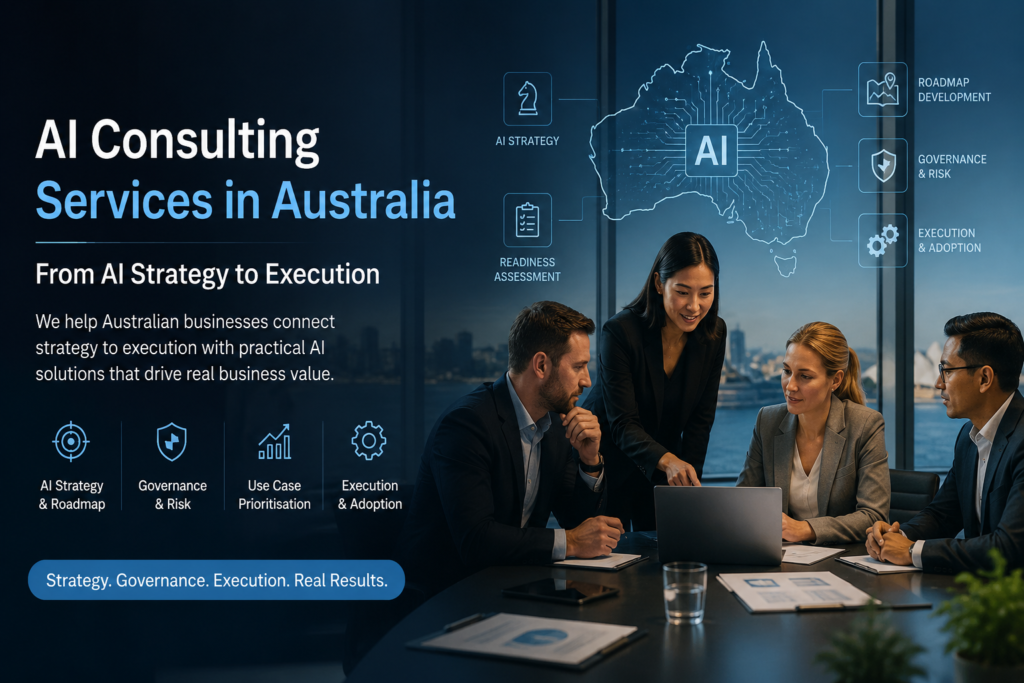
AI consulting services can support businesses in connecting business goals to realistic opportunities, evaluating AI maturity and readiness, defi ning governance strategies, identifying and prioritising use cases, and delivering practical advice and guidance throughout the process.
At Axiora Labs AI we can help Australian businesses get from strategy to execution with our strategic, business-focused approach to AI consulting and implementation, delivering value and helping organisations derive tangible business benefi ts from artifi cial intelligence.
Introduction to AI Consulting
AI consulting services can play a key role in helping organisations determine how they can best leverage artifi cial intelligence. Consulting services often focus on strategy, implementation, and governance, helping businesses to understand the opportunities and risks presented by AI while supporting realistic, value-focused adoption and execution.
Unlike technology-focused consulting services, AI consulting typically focuses fi rst on the business – examining business goals, challenges, and requirements before connecting business needs to opportunities in AI.
This process might involve considering:
- Business needs
- Challenges and pain points
- Opportunities and requirements
- Current processes
- Technology and data
- Customers
- Employees
- Security
- Governance and compliance
- Other factors
The overall goal is to determine how AI can provide tangible business benefi ts and be deployed in a way that supports the organisation’s strategic objectives. Some businesses may need help understanding their strategic objectives or identifying realistic opportunities. Other businesses may need assistance selecting and prioritising opportunities for execution.
Why Do Australian Businesses Need AI Consulting Services?
Many organisations can benefi t from artifi cial intelligence, but businesses often need guidance when it comes to determining what makes the most sense for their unique needs and requirements.
AI consulting services can help Australian organisations determine how and where to apply artifi cial intelligence while managing costs, maximising benefi ts, and supporting realistic execution.
Align Business Objectives With AI Opportunities
Businesses need to ensure that artifi cial intelligence is connected to clear objectives that refl ect their strategic priorities. Artifi cial intelligence should be leveraged to:
- Drive productivity and reduce costs
- Generate new revenue streams and increase profi ts
- Improve the customer experience
- Increase revenues
- Make better decisions and reduce error rates
- Reduce manual effort and paperwork
- Improve access to information
- Empower employees
- Support other business goals
AI consulting can help connect business objectives with realistic opportunities and technologies.
Identify High-Impact AI Opportunities
Most organisations can identify a number of potential opportunities where AI could create value. The challenge is often deciding which opportunities should be pursued. Opportunities should be prioritised based on a variety of factors, including:
- Business impact
- Technical requirements
- Data availability
- Project size and complexity
- Security and governance requirements
- Implementation timeline
- Required investment
- Return on investment
- Other factors
It is often necessary to evaluate opportunities based on these factors to determine which ones should be prioritised.
Reduce AI Implementation Risks
Artifi cial intelligence presents many opportunities, but it also carries substantial risks. Many organisations fi nd that AI projects can be challenging to execute due to unrealistic expectations, inadequate data, governance challenges, and other issues.
Consulting services can help organisations reduce risks and ensure that AI opportunities are executed effectively.
Transition From AI Strategy to Execution
Many organisations fi nd that developing an AI strategy is relatively straightforward, but they then encounter substantial challenges when it comes to actually executing their strategy.
Strategy must be connected to execution, and consulting services can help organisations develop realistic strategies while identifying priorities, use cases, roadmaps, and other factors that support successful execution.
Services
Axiora Labs AI can support organisations in Australia in a variety of ways, based on their needs and objectives. We offer a range of AI consulting services to help businesses move through the process of AI adoption in an organised manner, connect their objectives to realistic opportunities, reduce implementation risks, accelerate execution, and maximise benefi ts.
AI Strategy Consulting
AI strategy consulting helps organisations defi ne their strategic objectives. This might include identifying priorities, evaluating potential use cases, developing implementation approaches, defi ning success metrics, and other needs. A strategy could include considerations such as:
- Priority use cases and opportunities
- Business goals
- Technology direction
- Investment priorities
- Governance requirements
- Success metrics
- Implementation priorities
- Other considerations
The overall goal is to create a strategy that aligns artifi cial intelligence with business objectives.
AI Readiness Assessment
Before adopting AI, businesses should ensure that they understand their needs and that they have the capabilities and resources required to adopt and implement artifi cial intelligence successfully. An AI readiness assessment might focus on factors such as:
- Data
- Technology
- Applications
- Cloud infrastructure
- Security
- Governance
- Capabilities
- Organisation
- Readiness
- Other relevant factors
This type of assessment helps businesses understand their needs, capabilities, and potential challenges.
AI Roadmap Development
An AI roadmap can help turn strategy into execution. It may incorporate a variety of factors, including considerations such as:
- Quick wins
- Pilot projects
- Strategic opportunities
- Technology requirements
- Data requirements
- Implementation timelines
- Dependencies
- Priorities
- Other relevant factors
This information is compiled into a roadmap that identifi es key initiatives, timelines, responsibilities, and other relevant considerations that will support strategy execution.
AI Governance Consulting
As organisations begin to leverage AI, they should implement appropriate governance policies that promote responsible adoption and management of artifi cial intelligence. AI governance can include considerations such as:
- Information privacy
- Information security
- Information access
- Human oversight
- Accountability
- Model performance
- Model security
- Transparency
- Auditability
- Risk management
- Other relevant factors
Governance policies help organisations manage the risks associated with AI while promoting model accountability, transparency, and responsible adoption.
AI Adoption Consulting
Many organisations fi nd that AI adoption is more challenging than they anticipated. It is often necessary to consider factors such as change management, training, documentation, and other relevant considerations to ensure that employees understand how to make the most of AI. Adoption consulting can be used to support considerations such as:
- Training
- Documentation
- Workfl ow design
- Change management
- Impact analysis
- Adoption metrics
- Feedback mechanisms
- Other relevant factors
The overall goal is to ensure that artifi cial intelligence is actually adopted and delivers demonstrable benefi ts to the organisation.
AI Transformation Consulting
Many organisations want to leverage AI across multiple business functions and realise substantial benefi ts. AI transformation consulting services support businesses in pursuing enterprise-level AI adoption. This type of consulting may include considerations such as:
- Enterprise strategy
- Process transformation
- Intelligent automation
- AI-driven decision-making
- Data transformation
- Employee empowerment
- Customer experience transformation
- AI-driven products and services
- Other considerations
This approach focuses on making AI a strategic enabler that helps the business derive substantial benefi ts from artifi cial intelligence.
How We Work With Our Clients
Most organisations need assistance turning strategy into execution. We follow an organised process that can help clients overcome challenges, identify opportunities, develop strategies, reduce risks, and accelerate execution.
1. Business Discovery
The fi rst step is to understand the business, its needs, its capabilities, and its strategic priorities. We work closely with the client to understand factors such as:
- Strategic objectives
- Business challenges
- Technology priorities
- Customers
- Data
- Applications
- Other relevant factors
2. AI Readiness Assessment
We then evaluate the business’s requirements, capabilities, and readiness for AI adoption. This process considers factors such as:
- Data
- Technology
- Applications
- Cloud infrastructure
- Security
- Governance
- Organisation
- Other relevant factors
This information is used to develop an understanding of the business’s strategic needs and requirements and what it will take to adopt and implement artifi cial intelligence.
3. AI Opportunity Identifi cation
We then examine the potential AI opportunities that could support the business’s strategic objectives. We focus on areas of highest interest and value, including:
- AI use cases
- Process automation
- Decision support
- Customer experience
- Employee productivity
- Knowledge management
- Data analysis
- Predictive analytics
- AI-powered products
- Other relevant factors
4. Use Case Prioritisation
Not all opportunities will have the same level of value or require the same resources for implementation. It is important to determine which opportunities should be prioritised. Factors such as the following should be considered:
- Business impact
- Value
- Viability
- Data requirements
- Complexity
- Risks
- Costs
- Return on investment
- Other relevant factors
5. AI Strategy Development
We then incorporate the opportunities and use cases into a comprehensive strategy that refl ects the organisation’s strategic objectives. The strategy development process considers factors such as:
- Priority use cases
- Business impact
- Technology requirements
- Governance requirements
- Other relevant factors
This information is used to develop a comprehensive strategy that serves as a reference for future initiatives.
6. Governance and Risk Planning
We also consider the organisational governance requirements and address relevant risks and challenges before proceeding with implementation and execution.
7. AI Roadmap and Execution Planning
The strategy is then used to develop an AI roadmap that incorporates the most compelling opportunities and use cases. The execution planning process considers factors such as:
- Priority projects
- Strategic opportunities
- Technology requirements
- Data requirements
- Dependencies
- Implementation requirements
- Roles and responsibilities
- Success metrics
- Other relevant factors
This information is used to develop a comprehensive execution plan that will support the organisation’s ability to execute its strategy.
Technologies We Work With
Many different technologies can be utilised to realise business value from artifi cial intelligence. The choice of technology often depends on the business requirements and opportunities.
Generative AI
Generative AI can be applied to a wide range of business-critical use cases, including:
- Content generation
- Document summarisation
- Knowledge retrieval
- Research assistance
- Customer communication
- Employee assistance
- Other relevant factors
Large Language Models
Large language models (LLMs) can play an important role in a variety of applications, including:
- Enterprise search
- Knowledge assistants
- Document analysis
- Customer support
- Internal copilots
- Other relevant factors
AI Agents
AI agents can be used to perform a variety of tasks that involve multiple steps and require interactivity with other systems and data, including:
- Workfl ow automation
- Research assistance
- Customer support
- Sales automation
- Internal operations
- Other relevant factors
Machine Learning
Machine learning algorithms can be used to extract valuable insights from data and support organisations in making better business decisions. Potential applications include:
- Forecasting
- Risk analysis
- Customer segmentation
- Recommendations
- Predictive maintenance
- Other relevant factors
Natural Language Processing
Natural language processing (NLP) enables computers to understand and process natural language and can be used to support a variety of business applications, including:
- Document classifi cation
- Information extraction
- Sentiment analysis
- Search
- Customer communication
- Other relevant factors
Predictive Analytics
Predictive analytics can help organisations make smarter decisions by providing insight into likely outcomes, including:
- Demand forecasting
- Customer analysis
- Operational planning
- Risk assessment
- Other relevant factors
Intelligent Automation
Intelligent automation can play a critical role in optimising operations and accelerating digital transformation. Applications include:
- Document processing
- Finance operations
- Back-office operations
- Customer support
- Approval processes
- Data movement
- Other relevant factors
Computer Vision
Computer vision enables computers to interpret visual information and can be used to support various business applications, including:
- Quality assurance
- Asset inspection
- Safety-critical applications
- Document recognition
- Visual analysis
- Other relevant factors
Industries We Serve
Axiora Labs AI can支援 a wide range of industries and business functions. We serve organisations across various sectors in Australia, including:
Logistics & Supply Chain
AI can be applied to logistics and supply chain management to support end-to-end operations, including:
- Forecasting
- Shipment tracking
- Inventory management
- Procurement
- Documentation
- Other relevant factors
Pharma & Life Sciences
Organisations in the pharmaceutical and life sciences fi elds can benefi t from AI in a variety of ways, including:
- Research assistance
- Document management
- Data-heavy applications
- Knowledge management
- Operational analytics
- Other relevant factors
Enterprise IT & GCCs
Enterprises and global shared services can leverage AI to support a variety of IT operations and business processes, including:
- IT operations
- Employee assistance
- Knowledge management
- Intelligent automation
- Enterprise productivity
- Other relevant factors
Manufacturing
Manufacturing organisations can utilise AI to support a variety of applications, including:
- Predictive maintenance
- Quality management
- Production analytics
- Supply chain planning
- Intelligent automation
- Process optimisation
- Other relevant factors
Banking & Financial Services
Banking and fi nancial services organisations can benefi t from AI in a variety of ways, including:
- Document processing
- Analytics applications
- Customer operations
- Employee productivity
- Internal operations
- Other relevant factors
Insurance
Insurance companies can derive substantial value from AI by applying it to:
- Claims management
- Policy operations
- Document processing
- Customer operations
- Knowledge management
- Other relevant factors
Healthcare
Healthcare facilities can benefi t from AI in a number of ways, including:
- Administrative support
- Document processing
- Schedule management
- Information management
- Operational support
- Other relevant factors
Note: Healthcare-specifi c regulations must be followed to ensure patient data confi dentiality and privacy.
Legal Services
Law fi rms and legal departments can benefi t from AI by applying it to:
- Document review
- Contract management
- Research assistance
- Knowledge management
- Administrative support
- Other relevant factors
Government & Public Sector
Government agencies can benefi t from AI by applying it to:
- Citizen services
- Information management
- Administrative support
- Knowledge management
- Employee productivity
- Other relevant factors
Why Choose Us for AI Consulting Services in Australia?
AI consulting services should help businesses get from strategy to execution. At Axiora Labs AI, our business-focused consulting services help organisations develop a practical understanding of what should be done, why it should be done, how it should be done, and how success should be measured.
Our approach includes:
- Business analysis
- AI opportunity identifi cation
- AI readiness assessment
- AI strategy development
- Governance planning
- Use case prioritisation
- AI roadmap development
- Adoption planning
- Execution guidance
These services can help businesses understand the opportunities and challenges associated with artifi cial intelligence while reducing risks and maximising value.
From AI Strategy to Execution
Strategic planning is an important consideration for any organisation, but strategy alone is not sufficient to realise value from artifi cial intelligence. A good strategy should include objectives and direction, while a good execution plan should then utilise that strategy to actually deliver value. Most organisations need to determine how they should proceed in a practical, realistic manner.
Many businesses start with a small number of high-impact use cases and then gradually move towards enterprise-wide adoption. This allows organisations to understand the value of artifi cial intelligence, reduce risk, and invest limited resources wisely. A realistic sequence might include:
- Identifying high-impact use cases
- Assessing data and technical requirements
- Addressing governance and ownership considerations
- Identifying one or more pilot projects
- Measuring and demonstrating value
- Enhancing the solution
- Adopting and scaling artifi cial intelligence
This approach can help organisations learn from their initial efforts, ensure that they are investing in the right opportunities, and begin to deliver value from artifi cial intelligence.
Get Started With AI Consulting Services in Australia
Artifi cial intelligence can deliver substantial benefi ts to Australian organisations, but most businesses need to get past the strategy phase and actually start delivering value. To do that, businesses need to understand the opportunities, apply appropriate technologies, address governance concerns, develop realistic strategies, and begin executing projects that deliver demonstrable benefi ts.
This is where our AI Consulting Services can help. We can assist organisations in Australia in developing strategies, planning transformations, addressing risks, and getting past strategy to actually deliver value.
If your business has begun to explore the potential of artifi cial intelligence but now needs assistance getting started, our business-focused consulting services are an excellent choice. Learn more about our AI Consulting Services and begin turning your ideas into reality.
Frequently Asked Questions
What Are AI Consulting Services?
AI Consulting Services help organisations identify AI opportunities, assess readiness, develop strategies, establish governance, prioritise use cases, and create implementation roadmaps.
What Does an AI Consultant Do?
An AI consultant analyses business needs and opportunities to identify how artifi cial intelligence can create value and recommends how opportunities should be prioritised and implemented.
How Does AI Consulting Help Move From Strategy to Execution?
AI consulting services can help turn strategic objectives into prioritised use cases, pilot projects, governance strategies, implementation approaches, and quantifi able success metrics.
What Is an AI Readiness Assessment?
An AI readiness assessment determines whether an organisation has the data, technology, systems, governance, skills, and processes required to implement artifi cial intelligence successfully.
What Is an AI Roadmap?
An AI roadmap is a plan that incorporates strategic objectives, implementation approaches, technology requirements, dependencies, responsibilities, pilot projects, and opportunities for scaling AI.
Does AI Consulting Include AI Governance?
Yes. AI governance is a crucial consideration for most organisations, particularly when adopting AI solutions that involve sensitive data, regulated processes, or enterprise-wide operations.
Can Australian SMEs Benefi t From AI Consulting Services?
Yes. Small and medium-sized enterprises can benefi t from identifying a limited number of high-impact opportunities and addressing readiness, governance, adoption, and other considerations in a practical manner.
What Happens After an AI Consulting Engagement?
After completing an AI consulting engagement, organisations can use the strategy and roadmap to develop proofs of concept, initiate pilot projects, select technologies, implement AI solutions, measure results, and scale successful initiatives.