AI product engineering services USA is a growing space as more and more companies are looking to design and develop AI products for their own use. From automating processes to improving customer experience and personalization, AI can help organizations achieve a variety of business goals.
However, an AI product is more than just the AI model itself. There are additional considerations like product strategy, software engineering, data and model development, cloud infrastructure, testing, and deployment. This is where AI product engineering services can be invaluable.
What Is AI Product Engineering?
AI product engineering refers to the design, development, and maintenance of software products that use artificial intelligence. Unlike traditional software development, building an AI product involves additional considerations, including:
- Product discovery and strategy
- UX/product design
- Software engineering
- AI and ML development
- Data engineering
- Cloud infrastructure
- Model deployment and monitoring
- MLOps
- Product testing and maintenance
For organizations in the USA, partnering with an AI product engineering company can be an excellent way to transform ideas into reality while ensuring scalability, security, performance, and other key product qualities.
Why Are US Businesses Investing in AI Products?
AI is being adopted in a variety of industries and used for a wide range of purposes. For example, businesses are using AI to automate processes, improve customer experience, analyze data sets, assist and train employees, and more.
Some of the most common applications of AI in the business world include:
- AI customer support
- Document processing
- Predictive analytics
- Recommendation systems
- Generative AI
- Computer vision
- AI SaaS products
- Intelligent automation
- Fraud detection
However, while a proof of concept can be relatively straightforward, building a product requires additional considerations. An AI product needs to be tested, monitored, and optimized. It also needs to be compatible with other systems and take into account data privacy and security laws.
AI Product Engineering Services for US Businesses
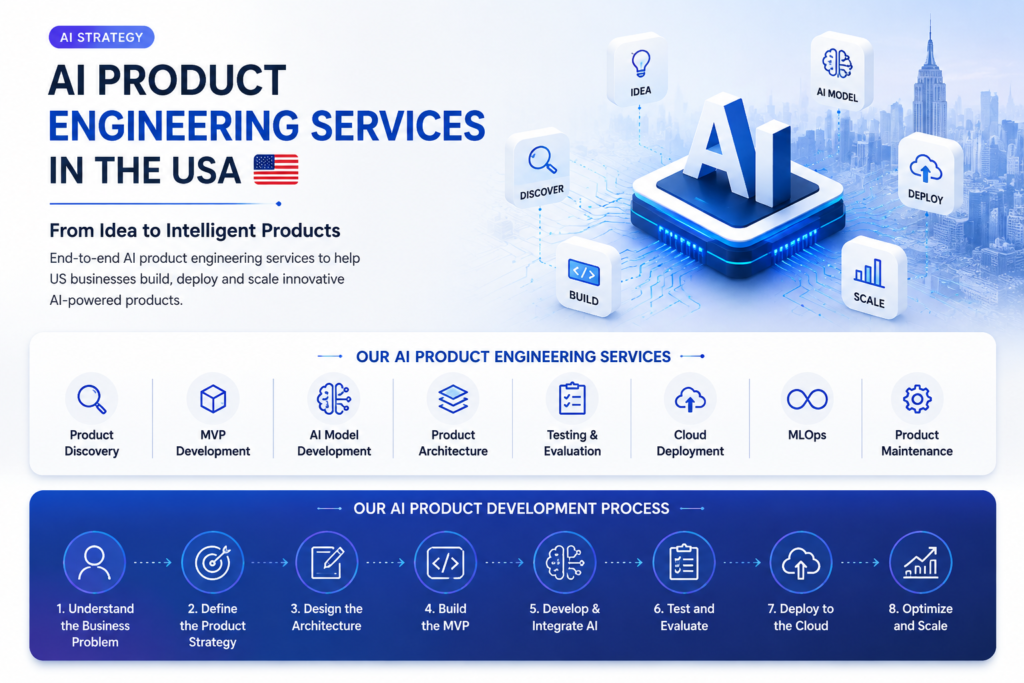
An experienced AI product engineering partner can help organizations design, develop, and maintain a product. Below are some of the services that are typically involved in building an AI product.
Product Discovery
The first step in building any product is product discovery. This phase is about figuring out what the product should be and what problems it should solve.
In the context of AI products, product discovery can involve:
- Business and user research
- AI use-case identification
- Technical feasibility analysis
- Competitor research
- Roadmapping
- MVP planning
- Technology selection
During this phase, organizations can determine what features their product should have and what value proposition it should offer.
MVP Development
Many businesses are hesitant to invest significant resources into a product without knowing if it will be viable. This is why developing an MVP (minimum viable product) is an important step in product development.
An MVP is essentially a product with just enough features to test the concept and get feedback from real users.
When it comes to AI products, an MVP can include:
- AI-powered workflows
- User dashboards
- APIs and backend services
- Authentication and authorization
- Third-party service integrations
- AI interfaces and chatbots
- Analytics and reporting
Once an MVP has been developed and tested, organizations can move on to developing the full-scale product.
AI Model Development
Depending on the use case, there are several different types of AI models that can be used. For example, generative AI can be used for tasks like text and image generation, while computer vision models are useful for analyzing and interpreting visual data.
Other common types of AI models include:
- Natural language processing models
- Machine learning models
- Predictive analytics models
- Recommendation system models
- Classification and forecasting models
When developing an AI product, businesses can either use existing foundation models or train custom machine learning models. The choice between the two depends on factors like data availability, performance requirements, cost, privacy, and more.
Product Architecture
When it comes to software products, architecture refers to the design and structure of the application. The same principle applies to AI products.
When designing the architecture for an AI product, developers and engineers must consider:
- Frontend and backend development
- AI model services
- Data pipelines
- Databases
- APIs
- Cloud infrastructure
- Security
- Monitoring
The architecture should be designed in a way that makes it easy to update and scale the product in the future.
Product Testing
Like any other software product, AI products need to be tested for bugs, errors, and performance issues. In addition, testing is crucial for ensuring that the AI model is performing as expected.
Some of the common types of testing performed for AI products include:
- Functional testing
- API testing
- Performance testing
- Security testing
- UX/UI testing
- Model testing
- AI response testing
Testing can help businesses identify and fix issues before the product is launched.
Cloud Deployment
Cloud deployment refers to hosting an application on cloud servers rather than on a local server. In the case of AI products, cloud deployment is essential because it enables organizations to scale their products as needed.
Some common cloud technologies that can be used for deploying AI products include:
- Cloud servers
- GPU instances
- Databases
- Storage
- APIs
- Security tools
- Monitoring and logging tools
By using cloud technologies, businesses can ensure that their products are secure, reliable, and easy to scale.
MLOps
MLOps refers to the set of practices that are used to operationalize, monitor, and maintain machine learning models. This is an important consideration for any business that wants to deploy an AI product because it can be challenging to operationalize machine learning models.
Some common MLOps practices include:
- Model versioning
- Data pipelines
- Automated model deployment
- Model monitoring
- Performance tracking
- Retraining workflows
- Experiment tracking
- Infrastructure automation
These practices can help organizations ensure that their AI models are performing optimally.
Product Maintenance
After a product has been launched, it requires ongoing maintenance to ensure that it continues to function properly.
Some common maintenance tasks performed for AI products include:
- Bug fixes
- Model optimization
- Performance improvements
- Security updates
- Infrastructure maintenance
- Feature development
- Model evaluation
- Cost optimization
- Technical support
By maintaining the product on a regular basis, organizations can ensure that it continues to meet the needs of their users.
Our AI Product Development Process
At AxioraLabs AI, we have a well-established product development process that we use to build AI products for our clients.
Understand the Business Problem
The first step in any product development project is to understand the problem that needs to be solved. We begin by discussing the business requirements, target audience, and desired outcomes.
Define the Product Strategy
Next, we work on developing the product strategy. This typically involves defining the product scope, core features, and technical requirements.
Design the Architecture
We then move on to designing the product architecture.
Build the MVP
The next step is to develop an MVP so that the product concept can be validated.
Develop and Integrate AI
We then proceed to develop the AI models and integrate them into the product.
Test and Evaluate
After the product has been developed, it is thoroughly tested and evaluated.
Deploy to the Cloud
The product is then deployed to the cloud.
Optimize and Scale
Finally, the product is optimized and scaled to ensure that it continues to meet the needs of the users.
Technologies Used for AI Product Engineering
The choice of technology depends on the requirements of the product. In general, an AI product typically consists of several components, including the application itself, the AI model, data storage and processing systems, and cloud infrastructure.
AI/ML Development
Python, PyTorch, TensorFlow, scikit-learn, NLP, computer vision, generative AI, and foundation models.
Backend
Python, Node.js, REST APIs, GraphQL, microservices, and serverless technologies.
Frontend
React, Next.js, TypeScript, and web application frameworks.
Data
PostgreSQL, MongoDB, Redis, data warehouses, vector databases, and data processing technologies.
Cloud
AWS, Microsoft Azure, Google Cloud, Docker, and Kubernetes.
MLOps
Model monitoring, CI/CD, experiment tracking, model versioning, automated model deployment, and observability.
The technologies should be selected based on the requirements of the product. It is a good idea to avoid using unnecessary technologies just because they are popular.
Industries We Build AI Products For
Healthcare
Healthcare organizations can benefit from a variety of AI applications, including clinical documentation, patient engagement, medical imaging, and administrative automation.
Financial Services
The financial services industry can leverage AI to detect fraud, provide intelligent customer support, and automate a variety of other processes.
Retail & E-commerce
Businesses in the retail and e-commerce space can use AI to improve personalization, recommend products, and optimize their operations.
Logistics & Transportation
Companies in the logistics and transportation industry can benefit from AI-powered demand forecasting, route optimization, and other solutions.
Manufacturing
AI can be used in a variety of ways in the manufacturing industry, including predictive maintenance, quality inspection, and production optimization.
Real Estate
The real estate industry can benefit from AI-powered property recommendation engines, document processing, and other applications.
SaaS & Technology
SaaS and technology companies can use AI to develop innovative products and solutions.
Why Choose AxioraLabs AI?
Building an AI product can be a complex endeavor. It requires a combination of product development expertise, software engineering knowledge, and AI/ML capabilities.
At AxioraLabs AI, we combine all of these areas to help organizations build high-quality AI products.
- End-to-end development: We offer a comprehensive range of services, from product discovery to MVP development, deployment, and maintenance.
- Business-centric approach: When developing AI products, we take a business-centric approach and focus on what makes sense from a business perspective.
- Scalable architecture: We design products with scalability in mind so that they can support future growth.
- Production-ready engineering: We have extensive experience in building production-grade applications.
- Flexibility: We can work with a variety of technologies depending on the requirements of the product.
- Continuous optimization: We believe in continuous improvement and continuously optimize the product based on user feedback and other factors.
Whether you are a small business looking to develop your first AI product or an established organization that wants to enhance your digital offerings, we can help you bring your idea to life.
FAQs About AI Product Engineering Services in the USA
How Much Does AI Product Engineering Cost in the USA?
The cost of AI product engineering depends on a variety of factors, including the complexity of the product, the amount of data that needs to be processed, the required infrastructure, and the size of the development team.
In general, you should expect to pay more for an enterprise-level product compared to an MVP.
How Long Does It Take to Build an AI Product?
The timeline for building an AI product varies depending on the complexity of the solution, the amount of data that needs to be processed, and the size of the development team.
In general, you can expect it to take several months to build an MVP and additional months to build a full-scale product.
Should We Build an AI Model From Scratch?
It is not always necessary to build an AI model from scratch. In some cases, you can use an existing foundation model or API.
Custom models are typically used when there is a need for greater accuracy, performance, or data privacy.
Can You Integrate AI Into an Existing Software Product?
Yes, it is possible to integrate AI into an existing software product. In fact, many companies choose this approach to enhance their existing solutions.
What Is the Difference Between AI Development and AI Product Engineering?
AI development typically refers to the process of building AI models, while AI product engineering is a broader term that refers to the entire product development lifecycle.
Why Is MLOps Important for AI Products?
MLOps is important because it helps organizations operationalize and maintain their machine learning models. As AI products become more complex, MLOps can help ensure that they are reliable and easy to maintain.