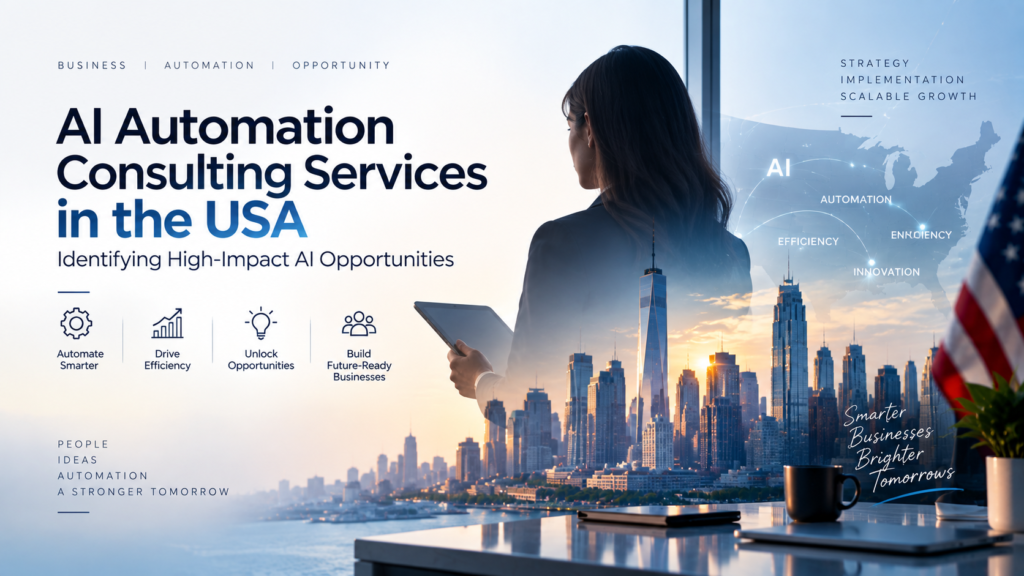
AI Automation Consulting Services in the USA
Artificial intelligence is reshaping how businesses across the United States operate, serve customers, analyze information, and improve productivity. However, the biggest challenge for most organizations is not understanding that AI has potential. It is knowing where AI should be applied, which opportunities are worth pursuing, and how to implement automation without wasting time or resources.
Should customer support be automated first? Can repetitive administrative work be reduced using AI? Which sales processes are suitable for intelligent automation? Is the organization’s current data and technology infrastructure ready to support AI?
These are the questions that make AI Automation Consulting valuable.
AI Automation Consulting helps businesses identify practical opportunities for using artificial intelligence and automation to improve operations. It combines business process analysis, AI opportunity identification, technology evaluation, ROI assessment, implementation planning, and strategic guidance.
Instead of adopting AI tools without a clear purpose, businesses can work with experienced consultants to understand where automation will create the greatest impact and how those opportunities should be prioritized.
At Axiora Labs AI, we help organizations across the USA evaluate their automation potential, identify high-value AI use cases, and develop realistic implementation strategies focused on measurable business outcomes.
What Is AI Automation Consulting?
AI Automation Consulting is a strategic service that helps businesses identify, evaluate, plan, and implement artificial intelligence and automation opportunities across their organization.
The purpose of AI Automation Consulting is not simply to recommend new AI software. The goal is to understand the business first.
Consultants examine how an organization currently operates, identify inefficient or repetitive processes, evaluate the company’s data and systems, determine where AI can create value, and develop a practical path toward implementation.
A typical AI Automation Consulting engagement may examine:
- Repetitive business processes
- Administrative workflows
- Customer support operations
- Sales processes
- Marketing activities
- Document-intensive tasks
- Finance operations
- Human resources
- Supply chain processes
- Internal reporting
- Data management
- Software integrations
- Decision-making workflows
Each potential opportunity can then be evaluated based on business value, technical feasibility, implementation complexity, resource requirements, risk, and expected return on investment.
The result is a clearer understanding of which AI automation opportunities are worth pursuing and how they should be implemented.
Why US-Based Businesses Need AI Automation Consulting
Businesses across the United States are experimenting with generative AI, AI agents, machine learning, intelligent automation, large language models, and other emerging technologies.
However, adopting AI without a clear business strategy can lead to fragmented tools, low adoption, unnecessary spending, and projects that fail to produce meaningful value.
AI Automation Consulting helps businesses approach AI from a practical and business-focused perspective.
Find High-Impact AI Automation Opportunities
Most organizations have many processes that could potentially be automated.
But not every automation opportunity deserves investment.
A process that takes a few minutes once a month may provide little value when automated. A workflow performed thousands of times every month could produce significant savings and productivity gains.
AI Automation Consulting helps organizations identify processes that are strong candidates for automation.
These often include processes with:
- High transaction volumes
- Frequent repetition
- Significant manual effort
- Large amounts of data
- Predictable workflows
- Long processing times
- Frequent errors
- Multiple handoffs
- Repetitive decision-making
- High operating costs
Consultants can then rank these opportunities based on their likely business impact.
Avoid Poor AI Investments
The AI market is expanding rapidly, and businesses now have access to thousands of platforms, tools, applications, and automation solutions.
The availability of technology does not mean every tool is right for every business.
Organizations can make poor AI investments when they:
- Purchase software employees do not use
- Adopt tools that duplicate existing systems
- Select platforms that do not integrate with current technology
- Automate low-value activities
- Invest in AI before preparing the required data
- Implement solutions without clear business objectives
- Choose technology before understanding the underlying process
AI Automation Consulting reduces these risks by beginning with the business problem rather than the technology.
The right AI solution should be selected only after the organization understands what it wants to improve and what value the automation is expected to produce.
Build a Realistic AI Automation Strategy
Successful AI transformation rarely happens through one large project.
Most organizations benefit from a phased approach.
AI Automation Consulting helps businesses separate potential initiatives into categories such as:
- Quick wins — Opportunities that can be implemented relatively quickly and provide measurable value.
- Strategic initiatives — Larger automation projects capable of improving important business processes.
- Long-term transformation opportunities — Projects that may require additional data preparation, system modernization, integrations, governance, or organizational change.
This allows businesses to build AI capabilities progressively instead of attempting to automate everything at once.
What Can AI Automation Consultants Help You Automate?
AI automation opportunities can exist across almost every department and function.
Operations
Operational teams often manage repetitive, administrative, and information-heavy processes.
Potential AI automation opportunities may include:
- Workflow routing
- Data synchronization
- Report generation
- Task assignment
- Internal approvals
- Document processing
- Operational analytics
- Exception detection
- Process monitoring
- Automated notifications
AI automation can help businesses streamline operations, reduce bottlenecks, and improve process consistency.
Customer Support
Customer service teams often spend significant time answering repetitive questions, categorizing tickets, searching for information, and preparing responses.
AI automation can support:
- AI chat assistants
- Ticket classification
- Ticket routing
- Knowledge-base search
- Suggested responses
- Conversation summarization
- Customer sentiment analysis
- Support agent copilots
- Automated follow-up
AI does not necessarily need to replace customer support teams. In many cases, the greater opportunity is to help employees work faster by giving them better information and automating repetitive tasks.
Sales
Sales professionals often spend significant time on activities that do not involve direct selling.
AI Automation Consulting can identify opportunities such as:
- Lead qualification
- CRM data entry
- Account research
- Sales email personalization
- Meeting summarization
- Follow-up automation
- Lead scoring
- Proposal generation
- Pipeline analytics
- Sales forecasting
Automating repetitive sales activities can allow representatives to spend more time building relationships and closing opportunities.
Marketing
Marketing teams manage large amounts of content, customer information, campaigns, research, and performance data.
AI automation opportunities may include:
- Content workflow automation
- Marketing analytics
- Customer segmentation
- Campaign reporting
- Lead enrichment
- Personalization
- Market research
- Performance insights
- Marketing data analysis
- Content repurposing
AI Automation Consulting helps marketing teams identify where automation can improve productivity without sacrificing quality or strategy.
Human Resources
Human resources teams often manage administrative, document-heavy, and information-intensive workflows.
Potential AI automation opportunities include:
- Candidate screening support
- Employee onboarding
- HR knowledge assistants
- Document processing
- Employee request management
- Interview scheduling
- Policy search
- Internal HR support
- Employee communication workflows
HR automation should also be evaluated carefully for privacy, fairness, governance, and human oversight requirements.
Finance
Finance teams often work with structured processes that contain repetitive data and document handling.
Potential opportunities include:
- Invoice processing
- Expense categorization
- Financial document extraction
- Reconciliation support
- Report generation
- Data validation
- Financial analysis
- Accounts payable workflows
- Expense review
- Financial reporting automation
Automation can reduce manual workloads while improving consistency and processing speed.
Supply Chain
Supply chain and logistics operations involve large amounts of information, coordination, documentation, and decision-making.
AI automation can potentially support:
- Demand forecasting
- Inventory analysis
- Shipment tracking
- Supplier document processing
- Logistics workflows
- Exception detection
- Operational reporting
- Procurement assistance
- Supplier communication
- Supply chain analytics
AI Automation Consulting can help identify which of these opportunities are most realistic based on the organization’s current systems and data.
Our AI Automation Consulting Process
At axioralabs.ai, our AI Automation Consulting approach is designed to move organizations from initial exploration to a clear, practical implementation strategy.
1. Discovery Workshop
The consulting process begins with understanding the business.
We work with relevant stakeholders to understand:
- Business objectives
- Operational challenges
- Existing technology
- Current automation
- Department-specific pain points
- Strategic priorities
- Growth goals
- Existing AI initiatives
This establishes the context required to identify meaningful automation opportunities.
2. Business Process Analysis
Next, we examine how important business processes currently operate.
We look for:
- Manual activities
- Repetitive tasks
- Data movement between systems
- Approval bottlenecks
- High-volume processes
- Process delays
- Employee dependencies
- Frequent errors
- Repetitive decisions
Understanding the current process is essential before determining how AI should be applied.
3. AI Automation Assessment
An AI Automation Assessment is an important part of the consulting process.
The assessment evaluates the organization’s workflows, systems, data, technology environment, and readiness for automation.
It helps answer questions such as:
- Which processes are good automation candidates?
- Which opportunities have the greatest potential impact?
- What data will be required?
- Are existing systems suitable for integration?
- What risks or dependencies need to be considered?
- Which opportunities should be prioritized first?
The assessment provides a structured foundation for the wider AI automation strategy.
4. AI Opportunity Identification
Once the business processes and technology environment are understood, we identify potential AI use cases.
These may include:
- Generative AI
- AI agents
- Intelligent document processing
- Workflow automation
- Predictive analytics
- Natural language processing
- Machine learning
- Internal AI assistants
- Customer-facing AI assistants
- Automated data analysis
- Knowledge assistants
- Decision-support systems
Each opportunity is matched to a specific business challenge or improvement objective.
5. ROI Assessment
AI automation should create measurable business value.
Potential opportunities can therefore be assessed against factors such as:
- Employee hours saved
- Processing-time reductions
- Cost savings
- Reduced manual errors
- Increased operational capacity
- Improved customer response times
- Productivity improvements
- Revenue opportunities
- Implementation costs
This helps businesses compare different initiatives and prioritize those with stronger potential returns.
6. AI Readiness Evaluation
A promising AI use case may still be difficult to implement if the organization is not ready.
AI readiness can include evaluating:
- Data availability
- Data quality
- Existing applications
- APIs and integrations
- Cloud infrastructure
- Security requirements
- Governance requirements
- Internal capabilities
- Change-management requirements
- Employee adoption considerations
This identifies the resources and improvements that may be necessary before implementation.
7. AI Automation Roadmap Development
The final stage involves developing a prioritized implementation roadmap.
The roadmap can include:
- High-priority automation opportunities
- Quick wins
- Strategic initiatives
- Technology requirements
- Integration requirements
- Expected business impact
- Implementation sequence
- Pilot opportunities
- Dependencies
- Scaling considerations
This gives leadership a practical plan for moving from AI ideas to implementation.
How We Prioritize AI Automation Opportunities
One of the most important parts of AI Automation Consulting is deciding what should be implemented first.
Not every use case should receive the same priority.
Business Impact
The first consideration is the potential value created by the automation.
This may include:
- Cost reduction
- Productivity improvements
- Increased revenue
- Faster processing
- Better customer experience
- Reduced employee workload
- Improved operational capacity
High-impact opportunities generally deserve greater attention.
AI Automation Feasibility
Some processes are much easier to automate than others.
Processes with clear rules, structured inputs, predictable outputs, and consistent workflows are often easier to automate.
More complex processes may require redesign before AI can be implemented effectively.
Data Readiness
Many AI initiatives depend on access to reliable data.
Before recommending an AI solution, businesses should understand:
- What data is available
- Where the data is stored
- Whether the data is accurate
- Whether the data can be accessed
- Whether the data can legally and securely be used
Poor data readiness can significantly limit the effectiveness of AI.
Implementation Complexity
Some automation opportunities may be implemented using existing systems and APIs.
Others may require:
- Custom AI development
- New integrations
- Cloud infrastructure
- Data engineering
- Workflow redesign
- Security changes
- System modernization
Implementation complexity should always be considered alongside expected business value.
Security and Governance
AI automation must also be evaluated from a risk and governance perspective.
Considerations may include:
- Data privacy
- Information security
- Access controls
- AI accuracy
- Human oversight
- Regulatory obligations
- Model governance
- Audit requirements
- Responsible AI policies
These considerations are particularly important in regulated industries.
Industries We Serve With AI Automation Consulting
AI automation can create value across a wide range of industries in the United States.
Axiora Labs AI works with organizations exploring AI opportunities across sectors including:
Logistics & Supply Chain
AI automation can support:
- Shipment monitoring
- Forecasting
- Logistics documentation
- Supplier communication
- Inventory management
- Exception detection
- Operational analytics
- Procurement processes
Pharma & Life Sciences
AI opportunities may include:
- Research support
- Documentation
- Data processing
- Knowledge management
- Operational workflows
- Internal reporting
- Information retrieval
Enterprise IT & GCCs
Enterprises and Global Capability Centers can use AI for:
- IT service operations
- Knowledge management
- Internal support
- Workflow automation
- Employee productivity
- Enterprise search
- Data analysis
Manufacturing
Manufacturers can explore AI automation for:
- Operational workflows
- Quality processes
- Predictive maintenance
- Supply chain management
- Documentation
- Analytics
- Production reporting
Banking & Financial Services
Financial organizations can use AI automation across:
- Document processing
- Customer operations
- Financial analysis
- Internal workflows
- Reporting
- Knowledge management
- Employee productivity
Insurance
Insurance companies may benefit from AI automation in:
- Claims workflows
- Policy administration
- Customer communication
- Data extraction
- Document review
- Internal operations
- Analytics
Healthcare
Healthcare organizations can evaluate AI automation for:
- Administrative operations
- Documentation
- Scheduling
- Data management
- Internal knowledge support
- Operational analytics
Healthcare AI initiatives should always consider relevant privacy, security, and regulatory requirements.
Legal Services
Law firms and legal departments can explore automation for:
- Document review
- Contract workflows
- Knowledge retrieval
- Research assistance
- Legal document processing
- Administrative workflows
- Internal knowledge management
Government & Public Sector
Public-sector organizations can evaluate AI opportunities for:
- Internal administration
- Information management
- Citizen service workflows
- Document processing
- Knowledge management
- Operational reporting
- Employee assistance
What You Receive From Our AI Automation Consulting Services
Effective AI Automation Consulting should provide actionable recommendations rather than a generic list of AI ideas.
Depending on the scope of the engagement, deliverables may include:
- Business process assessment
- AI Automation Assessment
- Automation opportunity mapping
- Prioritized AI use cases
- AI readiness evaluation
- Technology recommendations
- Integration considerations
- Risk and dependency analysis
- ROI assessment
- Quick-win identification
- Strategic opportunity recommendations
- Implementation roadmap
- Pilot recommendations
- Recommended next steps
These deliverables help leadership make informed decisions about where AI investment should be directed.
Why Choose Axiora Labs AI for AI Automation Consulting in the USA?
The value of AI consulting depends on the ability to connect technology with measurable business outcomes.
At Axiora Labs AI, we take a business-first approach to AI automation.
Our focus is not on recommending technology simply because it is new. We focus on identifying practical opportunities where AI can help businesses improve efficiency, reduce repetitive work, make better use of data, improve customer experiences, and scale operations.
Our AI Automation Consulting approach combines:
- Business process analysis
- AI Automation Assessment
- AI opportunity discovery
- Automation strategy
- Technical feasibility evaluation
- AI readiness assessment
- ROI-focused prioritization
- Implementation planning
- AI roadmap development
This helps organizations understand not only what AI can do, but what AI should do within their business.
From AI Opportunities to Measurable Business Impact
AI transformation does not need to begin with a major enterprise-wide initiative.
For many businesses, the strongest starting point is identifying a small number of automation opportunities capable of delivering clear results.
For example, an organization may begin by automating:
- Repetitive document processing
- Customer support classification
- Internal reporting
- Data entry
- Sales follow-ups
- Employee knowledge search
Once these projects demonstrate value, additional automation initiatives can be introduced.
This approach allows organizations to develop practical experience with AI while controlling risk and investment.
AI Automation Consulting helps businesses answer important questions before committing resources:
- Where can AI deliver the greatest value?
- Which processes should be automated first?
- What technologies are required?
- Is the company’s data ready?
- What integrations are necessary?
- What implementation risks should be considered?
- What ROI can realistically be expected?
- How should automation scale over time?
These answers help turn AI from a collection of experiments into a structured business strategy.
Start Your AI Automation Consulting Journey
Your organization may already contain dozens of processes that could benefit from artificial intelligence and automation.
The challenge is deciding which ones are worth pursuing.
Axiora Labs AI helps businesses across the USA evaluate automation opportunities, assess AI readiness, identify high-impact use cases, and develop realistic implementation roadmaps.
Instead of experimenting with disconnected AI tools, organizations can take a structured approach focused on real business problems and measurable outcomes.
Schedule an AI Automation Consulting session with Axiora Labs AI and identify where artificial intelligence can create the greatest value in your organization.
Learn more about our AI services at axioralabs.ai.
Frequently Asked Questions
What Is AI Automation Consulting?
AI Automation Consulting helps organizations identify, evaluate, prioritize, and plan the implementation of artificial intelligence and automation opportunities across their business processes.
What Does an AI Automation Consultant Do?
An AI Automation Consultant analyzes business workflows, identifies potential automation opportunities, evaluates technical feasibility and readiness, estimates potential business value, recommends suitable technologies, and develops an implementation roadmap.
How Do You Identify Processes Suitable for AI Automation?
Strong candidates usually include repetitive, high-volume, rule-based, data-intensive, or time-consuming processes. Consultants evaluate each opportunity based on business impact, technical feasibility, data readiness, complexity, and risk.
Does AI Automation Consulting Include an AI Automation Assessment?
Yes. An AI Automation Assessment can form an important part of the wider consulting process. It helps evaluate business processes, systems, data, and organizational readiness before automation opportunities are prioritized.
How Can AI Automation Consulting Improve ROI?
AI Automation Consulting helps organizations focus investment on use cases with stronger potential business value. This can reduce unnecessary technology spending and prioritize opportunities capable of improving productivity, reducing costs, accelerating processes, or increasing operational capacity.
Is AI Automation Consulting Only for Large Enterprises?
No. Small businesses, mid-sized companies, and large enterprises can all benefit from AI Automation Consulting. The scope and complexity of the strategy can be adjusted based on the organization’s size, systems, resources, and business objectives.
What Happens After an AI Automation Consulting Engagement?
After the consulting engagement, businesses can prioritize recommended use cases, develop proofs of concept, launch pilot projects, implement selected automation solutions, measure results, and gradually scale successful initiatives.
How Long Does It Take to Implement AI Automation?
Implementation timelines depend on the complexity of the process, data readiness, integration requirements, security considerations, and whether the organization uses an existing AI platform or requires a custom solution. A consulting engagement helps estimate realistic implementation timelines before development begins.