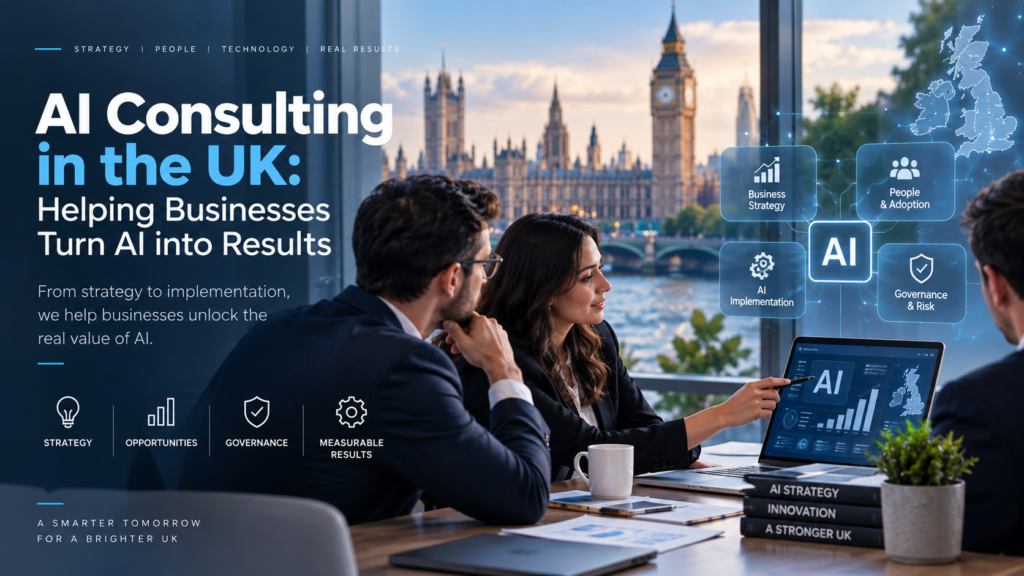
AI Consulting in the UK
Artificial intelligence is becoming an important part of how UK businesses improve efficiency, strengthen customer experiences, analyse information, and create new opportunities for growth.
Organisations across financial services, logistics, manufacturing, healthcare, technology, legal services, and the public sector are exploring generative AI, machine learning, AI agents, intelligent automation, predictive analytics, and other AI technologies.
But using AI tools is not the same as building a successful AI strategy. The real challenge is turning AI investment into measurable business results.
Which AI opportunities should be prioritised? Is the organisation ready for implementation? What data and technology are required? How should AI risks be managed? And how can individual AI projects support wider business objectives?
This is where AI Consulting Services can provide clarity.
AI consulting helps organisations move from experimentation to structured adoption by connecting business goals with practical AI opportunities, assessing readiness, developing governance, and building a roadmap for implementation.
At Axiora Labs AI, we help UK businesses develop practical AI strategies designed around measurable outcomes, operational priorities, and long-term growth.
What Is AI Consulting?
AI consulting is a strategic service that helps organisations determine how artificial intelligence can support business objectives.
Rather than beginning with a particular technology, AI consultants first understand the organisation.
This may involve analysing:
- Business goals
- Operational challenges
- Existing processes
- Technology infrastructure
- Available data
- Customer needs
- Workforce capabilities
- Security requirements
- Governance requirements
- Existing AI initiatives
The purpose is to identify realistic AI opportunities and define how those opportunities should be prioritised and implemented.
AI consulting can support organisations at different stages of adoption. Some businesses may be exploring AI for the first time. Others may already have pilot projects in place but need a stronger strategy for scaling AI across the organisation.
Why UK Businesses Need AI Consulting Services
AI adoption can create significant opportunities, but poorly planned initiatives can also result in wasted investment, fragmented systems, low employee adoption, and unnecessary risk.
AI Consulting Services help businesses make better decisions before committing significant resources.
Connect AI With Business Objectives
AI should support specific business priorities.
These may include:
- Improving productivity
- Reducing operational costs
- Increasing revenue
- Improving customer experience
- Accelerating decision-making
- Automating repetitive work
- Improving access to information
- Supporting employees
- Developing new products or services
AI consultants help organisations connect these objectives with suitable technologies and use cases.
This creates a stronger business case for AI investment.
Identify High-Value AI Opportunities
Most organisations can identify many possible AI use cases. The challenge is determining which ones deserve attention first.
Potential opportunities can be evaluated according to:
- Business impact
- Technical feasibility
- Data availability
- Implementation complexity
- Investment requirements
- Security considerations
- Governance requirements
- Expected ROI
This helps leadership prioritise initiatives that have a realistic chance of producing meaningful results.
Reduce AI Implementation Risk
AI initiatives can face problems when businesses overlook important foundations.
Common challenges include:
- Poor data quality
- Limited integration capabilities
- Inadequate infrastructure
- Weak security controls
- Unclear ownership
- Low employee adoption
- Limited governance
- Unrealistic expectations
AI consulting helps identify these risks early and determine what needs to be addressed before implementation.
Move Beyond AI Experimentation
Experimenting with AI tools can be useful, but individual experiments do not automatically create a scalable AI strategy.
Businesses need a coordinated approach that defines:
- Priority use cases
- Technology requirements
- Data requirements
- Governance principles
- Responsibilities
- Implementation sequence
- Success metrics
- Scaling opportunities
This helps organisations move from isolated experimentation to structured AI adoption.
Our AI Consulting Services
Axiora Labs AI supports organisations across different stages of their AI journey.
AI Strategy Consulting
AI strategy consulting helps businesses define how artificial intelligence should support wider organisational goals.
A strategy may include:
- Priority AI opportunities
- Business objectives
- Technology direction
- Investment priorities
- Organisational requirements
- Success measures
- Implementation priorities
The aim is to ensure AI investment is aligned with business value.
AI Readiness Assessment
Before implementing AI, organisations need to understand whether they have the right foundations.
An AI readiness assessment can evaluate:
- Data availability
- Data quality
- Existing systems
- Integration capabilities
- Cloud infrastructure
- Security controls
- Internal expertise
- Governance
- Organisational readiness
- Change-management requirements
Identifying readiness gaps early can reduce implementation delays and risk.
AI Roadmap Development
An AI roadmap translates strategy into a practical sequence of initiatives.
A roadmap can define:
- Quick wins
- Pilot projects
- Strategic AI initiatives
- Technology requirements
- Data preparation
- Integration requirements
- Dependencies
- Implementation priorities
- Scaling opportunities
This gives leadership a clearer path from planning to execution.
AI Governance Consulting
As AI becomes more widely used across an organisation, governance becomes increasingly important.
AI governance can cover:
- Data privacy
- Information security
- Access controls
- Human oversight
- Model performance
- Transparency
- Accountability
- Auditability
- Risk management
- Responsible AI practices
Governance helps organisations manage AI consistently and responsibly.
AI Adoption Consulting
Successful AI implementation depends on people as much as technology.
AI adoption consulting helps organisations prepare employees and workflows for AI-enabled ways of working.
This can include:
- Identifying affected roles
- Redesigning workflows
- Employee training
- Usage guidelines
- Change-management planning
- Adoption measurement
- Feedback processes
The objective is to make AI useful in day-to-day business operations.
AI Transformation Consulting
AI transformation consulting supports organisations that want to embed AI across multiple areas of the business.
This may involve:
- Enterprise AI strategy
- Process redesign
- Intelligent automation
- AI-enabled decision-making
- Data modernisation
- Employee productivity
- Customer experience
- AI-enabled products and services
The goal is to turn AI from a collection of projects into a long-term organisational capability.
Our AI Consulting Process
A structured process helps organisations move from uncertainty to practical implementation.
1. Business Discovery
The process begins by understanding the organisation’s goals, challenges, systems, and priorities.
We may review:
- Strategic objectives
- Operational challenges
- Existing technology
- Customer needs
- Data availability
- Current AI initiatives
- Growth priorities
2. AI Readiness Assessment
The organisation’s readiness is then evaluated across areas such as data, infrastructure, systems, security, governance, and internal capabilities.
This helps identify gaps that could affect implementation.
3. AI Opportunity Identification
Potential AI opportunities are identified across relevant business functions.
These may include:
- Automation
- Decision support
- Customer experience
- Knowledge management
- Predictive analytics
- Employee productivity
- Data analysis
- AI-enabled products
4. Use Case Prioritisation
Not every identified use case should be implemented immediately.
Opportunities can be ranked based on:
- Business impact
- Feasibility
- Data readiness
- Risk
- Complexity
- Cost
- Expected ROI
5. AI Strategy Development
Priority opportunities are brought together into a wider AI strategy.
The strategy defines what should be implemented, why it matters, and how AI supports broader business objectives.
6. Governance and Risk Planning
Security, privacy, accountability, human oversight, and responsible AI considerations are incorporated into the strategy.
This creates stronger foundations for implementation and future scaling.
7. AI Roadmap Development
The strategy is translated into a practical roadmap.
The roadmap can define:
- Priority projects
- Pilot initiatives
- Technology requirements
- Data preparation
- Dependencies
- Responsibilities
- Success measures
- Scaling plans
AI Technologies We Work With
Different business challenges require different AI capabilities.
Generative AI
Generative AI can support:
- Content creation
- Document summarisation
- Research
- Knowledge retrieval
- Customer communication
- Employee assistance
Large Language Models
Large language models can power applications that understand and generate natural language.
Potential uses include:
- Enterprise search
- Internal knowledge assistants
- Document analysis
- Customer support
- AI copilots
AI Agents
AI agents can perform multi-step activities by interacting with systems, tools, and business data.
Potential applications include:
- Workflow automation
- Research
- Customer operations
- Sales support
- Internal business processes
Machine Learning
Machine learning can help organisations identify patterns and make predictions.
Applications may include:
- Forecasting
- Risk analysis
- Customer segmentation
- Recommendations
- Predictive maintenance
Natural Language Processing
Natural language processing can help businesses analyse and understand written or spoken information.
Potential uses include:
- Document classification
- Information extraction
- Sentiment analysis
- Search
- Customer communication
Predictive Analytics
Predictive analytics helps organisations use historical data to anticipate future outcomes.
Applications may include:
- Demand forecasting
- Customer behaviour
- Operational planning
- Risk assessment
Intelligent Automation
Intelligent automation combines AI with workflow and process automation.
It can support:
- Document processing
- Finance workflows
- Customer service
- Back-office operations
- Approvals
- Data movement
Computer Vision
Computer vision enables AI systems to analyse images and video.
Potential applications include:
- Quality inspection
- Asset monitoring
- Safety applications
- Document recognition
- Visual analysis
Industries We Serve
Axiora Labs AI supports organisations across a range of industries.
Logistics & Supply Chain
AI can support forecasting, shipment visibility, inventory planning, procurement, documentation, and operational decision-making.
Pharma & Life Sciences
Potential applications include research support, document processing, knowledge management, data analysis, and operational workflows.
Enterprise IT & GCCs
Enterprises and Global Capability Centres can use AI for IT operations, knowledge management, employee support, workflow automation, and enterprise productivity.
Manufacturing
Manufacturers can explore AI for predictive maintenance, quality management, production analytics, supply chain planning, and operational automation.
Banking & Financial Services
Financial organisations can use AI for analytics, document processing, customer operations, employee productivity, and internal workflows.
Insurance
Potential applications include claims support, policy operations, customer service, knowledge management, and document processing.
Healthcare
Healthcare organisations may explore AI for administrative processes, information management, documentation, scheduling, and operational support while maintaining appropriate privacy and governance controls.
Legal Services
Law firms and legal departments can use AI for document review, contract workflows, research support, knowledge retrieval, and administrative processes.
Government & Public Sector
Public-sector organisations can evaluate AI opportunities across citizen services, information management, administrative workflows, knowledge systems, and employee productivity.
Why Choose Axiora Labs AI for AI Consulting in the UK?
AI consulting should provide practical guidance rather than theoretical recommendations.
At Axiora Labs AI, we focus on connecting AI with real business needs.
Our approach combines:
- Business analysis
- AI opportunity discovery
- AI readiness assessment
- Strategy development
- Governance planning
- Use case prioritisation
- AI roadmap development
- Adoption planning
The objective is to help organisations understand what AI opportunities are worth pursuing, what foundations are required, and how success should be measured.
Turning AI Strategy Into Business Results
A successful AI strategy should eventually produce measurable outcomes.
These outcomes may include:
- Lower operating costs
- Improved productivity
- Faster processing
- Better customer experiences
- Increased revenue
- More effective decision-making
- Better use of organisational knowledge
- Greater operational capacity
However, results rarely come from implementing every AI opportunity at once.
A practical approach often involves:
- Identifying high-value use cases.
- Assessing organisational readiness.
- Selecting one or more pilot projects.
- Measuring results.
- Improving the solution based on feedback.
- Scaling successful initiatives.
This allows organisations to build experience while controlling cost and risk.
The goal is not simply to adopt more AI.
The goal is to create an AI capability that produces sustainable business value.
Start Turning AI Into Business Results
Artificial intelligence can create significant opportunities, but businesses need clarity on where to begin and how to move from experimentation to measurable outcomes.
Axiora Labs AI helps UK organisations develop AI strategies, assess readiness, prioritise high-value use cases, establish governance, and build practical implementation roadmaps.
If your organisation is exploring AI and needs a clearer path from strategy to execution, a structured consulting approach can help turn ideas into practical initiatives.
Explore our AI Consulting Services and start building an AI roadmap focused on measurable business results.
Frequently Asked Questions
What Are AI Consulting Services?
AI Consulting Services help organisations identify AI opportunities, assess readiness, develop strategy, plan governance, prioritise use cases, and create practical implementation roadmaps.
What Does an AI Consultant Do?
An AI consultant analyses business goals, processes, data, and technology to determine where artificial intelligence can create value and how those opportunities should be implemented.
Why Do UK Businesses Need an AI Strategy?
An AI strategy helps businesses connect AI investment with defined objectives, avoid disconnected experiments, prioritise high-value use cases, manage risk, and plan implementation.
What Is an AI Readiness Assessment?
An AI readiness assessment evaluates whether an organisation has the data, systems, infrastructure, governance, skills, and processes required to support AI adoption.
What Is an AI Roadmap?
An AI roadmap is a structured implementation plan outlining priority initiatives, dependencies, technology needs, pilot projects, responsibilities, and scaling opportunities.
Does AI Consulting Include AI Governance?
Yes. AI governance can be an important part of consulting, particularly for organisations managing sensitive data, regulated processes, or enterprise-wide AI adoption.
Can SMEs Benefit From AI Consulting?
Yes. Small and mid-sized organisations can benefit by identifying a limited number of high-value opportunities and avoiding unnecessary investment in disconnected AI tools.
What Happens After an AI Consulting Engagement?
Businesses can use the resulting strategy and roadmap to build proofs of concept, launch pilots, select technology, implement solutions, measure results, and scale successful AI initiatives.