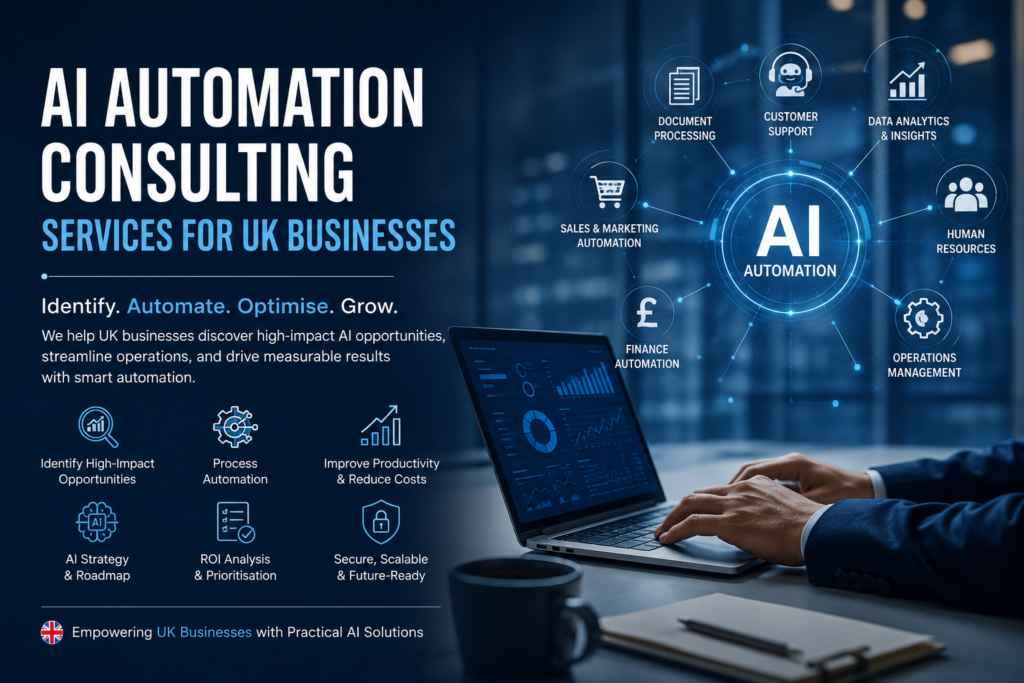
Artificial intelligence is transforming the way UK-based businesses operate, engage customers, analyse data, and optimise processes. From financial services and manufacturing to healthcare, logistics, legal services, and enterprise IT, organisations are seeking to leverage AI to drive innovation and efficiency. However, adopting artificial intelligence is not as simple as choosing the right software. The key challenge is to understand where artificial intelligence can create value. Which processes should be automated? Where do employees waste time on repetitive tasks? Can the organisation’s data be utilised for AI-driven insights? Are there systems that can be integrated with automation solutions? Which AI opportunities have the best ROI potential? This is where AI Automation Consulting comes in. AI Automation Consulting helps organisations to identify automation opportunities, assess their feasibility, understand technology and data requirements, evaluate potential ROI, and define implementation approaches. At Axiora Labs AI, we help UK-based organisations to identify the most compelling applications of artificial intelligence and develop realistic strategies for embedding AI automation across their operations.
What Is AI Automation Consulting?
AI Automation Consulting refers to the discipline of identifying, analysing, prioritising, and planning artificial intelligence and automation opportunities for an organisation. The focus is on understanding the business processes that can benefit from automation rather than on selecting specific technologies or tools. AI Automation Consultants typically work with businesses to understand their operations, systems, data, challenges, and goals. Some of the areas that are reviewed in the context of AI Automation Consulting include:
- Customer service processes
- Sales operations
- Marketing activities
- Finance functions
- Human resources
- Document-intensive processes
- Internal reporting
- Supply chain operations
- Data management
- Knowledge management
- Software and system integrations The aim is to identify the opportunities that would benefit from being automated and to define their priority. A key principle of AI Automation Consulting is that the focus should be on the business problems that need to be addressed with automation, not on the tools or technologies.
Why UK-Based Businesses Need AI Automation Consulting
Organisations across the UK are experimenting with generative AI, AI agents, machine learning, intelligent automation, and large language models. However, experimentation alone is not enough, and businesses need to be able to connect their use cases for AI to tangible outcomes. AI Automation Consulting enables organisations to make the right choices when it comes to adopting automation solutions.
Identify High-Impact AI Automation Opportunities
Most organisations have dozens of processes that could benefit from being automated. However, it is important to identify the opportunities that have the best potential to deliver value. An AI automation opportunity may be defined by its potential to reduce costs, improve productivity, create capacity, enhance customer experiences, or realise other benefits. At the same time, the opportunity should have realistically achievable outcomes and should not require significant resources to implement. AI automation consultants typically focus on processes that have the following characteristics:
- High transaction volumes
- Repetitive elements
- Significant manual effort
- High rates of information exchange
- Predictable patterns
- Lengthy processing times
- High potential for errors
- Multiple handoffs between systems
- Large amounts of documentation
- Repetitive decision-making These are just some of the factors that should be considered when identifying high-impact automation opportunities.
Avoid Wrong AI Investments
Businesses have thousands of options when it comes to adopting AI automation solutions. However, it is important to ensure that the selected opportunities align with the organisation’s needs and are realistically achievable. Wrong AI investments often stem from organisations’ attempts to purchase software or solutions without defining their business problems or opportunities. Some of the most common mistakes include:
- Buying tools that are not used
- Acquiring solutions that provide limited value
- Purchasing systems that cannot be integrated
- Automating processes with limited business impact
- Making AI investments before preparing data
- Failing to consider security requirements
- Adopting AI solutions without defined ownership AI Automation Consulting helps organisations to avoid these mistakes by focusing on their business requirements and opportunities rather than on available solutions and tools.
Define a Realistic AI Strategy
Many organisations that want to adopt AI solutions attempt to transform their operations at once. However, a more realistic approach is to identify a limited number of automation opportunities, implement them, and build on the results. Most AI initiatives can be grouped into the following categories:
- Quick wins: Opportunities that deliver value with limited implementation complexity.
- Strategic opportunities: Larger initiatives that have the potential to realise significant benefits.
- Long-term transformations: Complex automation opportunities that typically require extensive preparation and support. A comprehensive AI strategy should include an assessment of these factors.
What Can AI Automation Consultants Help UK-Based Businesses Automate?
Artificial intelligence can be applied across a wide range of functions and processes. The most compelling opportunities will be defined by the organisation’s specific systems, operations, data, and goals. Some of the key areas that can benefit from AI automation include the following:
Operations
Operational processes often involve a variety of repetitive and information-intensive activities. AI automation can be applied to:
- Workflow management
- Information exchange
- Report generation
- Task management
- Approvals
- Document-intensive processes
- Operational analytics
- Alert management
- Exception detection
- Process monitoring AI can help to reduce the burden of administrative and repetitive tasks.
Customer Support
Customer service processes often involve answering similar questions, classifying and routing queries, searching for information, and generating responses. AI automation can help to:
- Automate chatbots and other digital assistants
- Classify and route customer queries
- Search and retrieve information
- Generate responses
- Summarise conversations
- Provide conversation copilots
- Enable follow-up activities AI can help to reduce the burden of repetitive customer support tasks and allow employees to focus on complex queries and issues.
Sales
Sales representatives often spend a significant amount of their time on administrative tasks rather than on engaging with customers. AI automation can help to:
- Qualify and score leads
- Update CRM systems
- Conduct account research
- Personalise outreach
- Summarise meetings
- Follow up with prospects
- Prepare proposals
- Analyse pipelines
- Forecast sales Administrative automation can free up time for sales representatives and allow them to focus on building relationships and closing deals.
Marketing
Marketing teams need to manage a large volume of information and content, create and analyse campaign data, conduct research, and engage with customers. AI can help to automate:
- Content creation and management
- Marketing analytics
- Audience segmentation
- Campaign reporting
- Lead enrichment
- Personalisation
- Market research
- Performance analysis
- Content repurposing
- Marketing data analysis AI automation can help to reduce the burden of administrative and repetitive tasks while enabling more compelling customer engagement.
Human Resources
HR professionals need to manage a variety of administrative and information-intensive processes. AI automation can help to:
- Automate employee onboarding
- Screen candidates
- Provide knowledge management solutions
- Schedule interviews
- Automate employee requests
- Process documents
- Search policies
- Provide internal support
- Communicate with employees HR departments should also consider the ethical implications of adopting AI solutions.
Finance
Finance departments typically have a number of highly structured, document-intensive processes that can benefit from AI automation. These include:
- Invoice processing
- Expense categorisation
- Financial document extraction
- Reconciliation
- Report generation
- Data validation
- Accounts payable automation
- Financial analysis
- Management reporting AI automation can help to reduce the burden of repetitive and administrative tasks.
Supply Chain
Supply chain management involves a variety of logistics-intensive processes, including demand planning, inventory management, shipment tracking, supplier management, and more. AI automation can help to:
- Analyse demand
- Manage inventory
- Track shipments
- Automate supplier documentation
- Automate logistics
- Assist with procurement
- Detect exceptions
- Generate reports
- Communicate with suppliers
- Conduct supply chain analytics The specific opportunities will be defined by the company’s data and systems.
Our AI Automation Consulting Process
At axioralabs.ai, we follow a systematic approach to help our clients to identify automation opportunities, understand their requirements, evaluate potential ROI, and develop an implementation roadmap.
1. Discovery Workshop
We start the AI Automation Consulting engagement by understanding the client’s requirements. We discuss:
- Business goals
- Key challenges
- Current systems
- Existing automation
- Pain points across departments
- Growth priorities
- Strategic objectives
- Current AI initiatives This information helps us to define the areas that would benefit from automation.
2. Business Process Analysis
We then move on to a detailed review of the key processes that can benefit from AI automation. We identify:
- Manual steps
- Repetitive elements
- Process bottlenecks
- Information exchange
- Approval processes
- Transaction volumes
- Processing delays
- Opportunities for reducing errors
- System dependencies This information enables us to understand the opportunities for automation.
3. AI Automation Assessment
An AI Automation Assessment is a key element of AI Automation Consulting. This assessment helps to identify the most compelling automation opportunities for the organisation. It typically includes a review of:
- Business processes
- Systems
- Data
- Integration requirements
- Organisational capabilities
- Implementation barriers The assessment enables consultants to answer questions such as the following:
- Which processes should be automated?
- Which opportunities have the best potential?
- What data will be required?
- Can existing systems be leveraged?
- What dependencies need to be considered?
- What opportunities should be prioritised? The results of the assessment help to define a realistic approach to AI automation.
4. AI Opportunity Identification
Having reviewed the key processes and their automation potential, we identify the most compelling opportunities. We typically focus on processes that:
- Have the potential to deliver significant benefits
- Can be realistically automated
- Align with the organisation’s strategic goals We then map relevant AI technologies to the use cases, such as:
- Generative AI
- AI agents
- Intelligent document processing
- Workflow automation
- Predictive analytics
- Machine learning
- Natural language processing
- Internal AI assistants
- Customer-facing AI assistants
- Automated analytics
- Knowledge assistants
- Decision-support solutions
5. ROI Assessment
We then conduct an ROI assessment to evaluate the potential benefits of the identified opportunities. We typically consider:
- Employee hours saved
- Reduction in processing time
- Operating cost reductions
- Error reduction
- Additional capacity
- Productivity improvements
- Enhanced customer experiences
- Revenue opportunities
- Implementation costs This information can be used to determine which automation opportunities have the best potential and should be prioritised.
6. AI Readiness Evaluation
Not all AI automation opportunities are equally viable, and organisations need to be aware of their readiness to adopt them. We can conduct an AI readiness evaluation that covers:
- Available data
- Data quality
- Existing applications
- APIs and system integrations
- Cloud infrastructure
- Security requirements
- Governance policies
- Internal expertise
- Change management needs
- Employee readiness This evaluation helps to identify potential gaps and challenges.
7. AI Automation Roadmap Development
The final step is to develop an AI Automation Roadmap. This roadmap typically includes:
- Priority use cases
- Quick-win opportunities
- Strategic opportunities
- Technology requirements
- Integration requirements
- Dependencies
- Business impact
- Pilot opportunities
- Implementation sequence
- Scaling considerations This roadmap provides organisations with a realistic perspective on how they can capitalise on AI automation.
How Should AI Automation Opportunities Be Prioritised?
An important aspect of AI Automation Consulting is the prioritisation of automation opportunities. Businesses need to consider several factors when prioritising AI opportunities, including:
Business Impact
The most important consideration is the potential impact that the automation opportunity can have on the business. This can include:
- Cost reduction
- Increased productivity
- Higher capacity
- Improved customer experiences
- Reduced processing time
- Additional revenue
- Reduced employee effort Opportunities with the highest potential impact should be prioritised.
AI Automation Feasibility
Some processes are more suitable for automation than others. Businesses should focus on opportunities that have realistic automation potential. Processes that are highly structured and that have clearly defined input and output parameters are typically the easiest to automate. At the same time, organisations should avoid opportunities that require extensive human judgement.
Data Readiness
Most AI automation opportunities are heavily data-driven, and businesses need to consider how much data they have and how ready it is for analysis. Key considerations include:
- Available information
- Information location
- Data quality
- Data accessibility
- Data permissions
- Data freshness These factors will influence the ability to realise value from AI automation.
Implementation Complexity
Some automation opportunities can be realised with limited complexity, while others require extensive changes to the organisation’s operations. Businesses need to take implementation complexity into consideration when prioritising automation opportunities. Some of the factors that influence complexity include:
- Availability of existing tools
- Need for new APIs
- Cloud infrastructure requirements
- Data engineering requirements
- Changes to business processes
- Security requirements
- Organisational changes Complexity should be weighed against the potential benefits.
Security, Privacy, and Governance
Many businesses need to consider the impact of AI automation on data privacy, security, and governance. This is especially true for organisations that operate in highly regulated industries and that process sensitive information. Key considerations include:
- Data privacy
- Information security
- Access controls
- Human oversight
- Accuracy and reliability
- Transparency
- Internal policies
- Regulatory compliance These factors should be carefully reviewed, especially for organisations that work with sensitive information.
Industries We Serve With AI Automation Consulting
Axiora Labs AI provides AI Automation Consulting to businesses across a variety of industries, including the following:
Logistics & Supply Chain
We help logistics and supply chain organisations to identify opportunities in shipment tracking, logistics documentation, forecasting, inventory analysis, supplier management, exception management, procurement, and supply chain analytics.
Pharma & Life Sciences
We help pharma and life sciences organisations to capitalise on opportunities in research, documentation, data processing, knowledge management, internal operations, information retrieval, and reporting.
Enterprise IT & GCCs
We help enterprise IT organisations and global capability centres to leverage AI automation in IT service operations, enterprise knowledge management, employee support, workflow automation, data analysis, enterprise search, and productivity improvement.
Manufacturing
We help manufacturing organisations to identify automation opportunities across operational workflows, quality processes, predictive maintenance, supply chain, documentation, production reporting, and analytics.
Banking & Financial Services
We help financial services organisations to capitalise on opportunities in document processing, customer operations, financial analysis, internal operations, reporting, employee assistance, and knowledge management.
Insurance
We help insurance organisations to leverage AI automation in claims processing, policy administration, document extraction, customer operations, analytics, internal operations, and knowledge retrieval.
Healthcare
We help healthcare organisations to realise the benefits of AI automation in administrative processes, documentation, scheduling, information management, internal knowledge support, and operational analytics. We also help healthcare clients to ensure that appropriate privacy, security, and governance controls are in place.
Legal Services
We help legal service organisations to capitalise on AI automation in document review, contract management, legal research support, knowledge retrieval, document processing, and administrative automation.
Government & Public Sector
We help government and public sector organisations to identify automation opportunities across administrative processes, document processing, citizen services, information management, internal knowledge systems, reporting, and employee assistance.
What You Receive From AI Automation Consulting
An effective AI Automation Consulting engagement should go beyond high-level recommendations and provide organisations with actionable insights. The specific deliverables will vary depending on the engagement’s scope, but they typically include the following:
- Business process analysis
- AI Automation Assessment
- AI opportunity identification
- Opportunity prioritisation
- AI readiness assessment
- Technical recommendations
- Integration considerations
- ROI analysis
- Risk assessment
- Quick-win identification
- Strategic opportunity identification
- Implementation roadmap
- Pilot opportunities
- Next steps These deliverables will enable the client to make informed decisions about their AI automation opportunities.
Why Choose Axiora Labs AI for AI Automation Consulting in the UK?
AI Automation Consulting requires a comprehensive understanding of both business processes and technology. At Axiora Labs AI, we take a business-led approach to AI automation. We help organisations to identify the opportunities that make the most sense for them rather than pushing for specific AI solutions. Our AI Automation Consulting approach combines the following elements:
- Business process analysis
- AI Automation Assessment
- AI opportunity identification
- Technical feasibility analysis
- AI readiness evaluation
- ROI-focused prioritisation
- Automation strategy
- Implementation planning
- AI roadmap development The objective is to help organisations to understand not only what AI can do but also what AI should do for their business.
From AI Experiments to Measurable Business Value
Many organisations start their AI journeys by experimenting with generative AI, AI agents, and large language models. While experimentation is important, businesses need to move from experimentation to measurable outcomes by connecting AI opportunities to their specific needs and goals. Organisations can start their AI transformation by identifying a few quick wins, such as automating repetitive document processing, customer service classification, internal reporting, sales administration, employee knowledge searches, or other document-intensive or highly repetitive processes. Once these opportunities have been realised, organisations can capitalise on additional automation possibilities. AI Automation Consulting helps organisations to make the right decisions and invest their resources in the opportunities that will deliver the best results.
Start Your AI Automation Consulting Journey
Your organisation likely has numerous processes that can benefit from being automated with artificial intelligence. The challenge is to identify the opportunities that will deliver the best results. Axiora Labs AI helps UK-based organisations to identify high-impact automation opportunities, assess their readiness, evaluate potential ROI, and develop realistic implementation roadmaps. Rather than experimenting with disconnected AI tools, organisations can invest in a structured AI strategy that is informed by a comprehensive understanding of their operations. Schedule an AI Automation Consulting engagement with Axiora Labs AI and discover how artificial intelligence can create value for your organisation. Learn more at axioralabs.ai.
Frequently Asked Questions
What Is AI Automation Consulting?
AI Automation Consulting refers to the discipline of identifying, analysing, prioritising, and planning artificial intelligence and automation opportunities for an organisation.
What Does an AI Automation Consultant Do?
An AI Automation Consultant helps organisations to identify and analyse automation opportunities, understand their technology and data requirements, evaluate potential ROI, and define an implementation approach.
What Is an AI Automation Assessment?
An AI Automation Assessment is a structured evaluation of an organisation’s processes, systems, data, and readiness that helps to identify automation opportunities that have the potential to deliver significant benefits. It typically forms part of a larger AI Automation Consulting engagement.
Which Business Processes Are Suitable for AI Automation?
Processes that have the potential to deliver value should be considered for automation. Some of the factors that should be considered when selecting processes for automation include their volume, repetitiveness, data intensity, length, predictability, and the potential impact of automation.
Does AI Automation Consulting Include ROI Analysis?
A comprehensive AI Automation Consulting engagement typically includes an assessment of the potential ROI of the opportunities. This can involve evaluating the potential productivity gains, reductions in operating costs, time saved, additional capacity, and other factors.
Can Small and Mid-Sized UK Businesses Use AI Automation?
Yes, small and mid-sized UK businesses can benefit from AI automation. In many cases, these organisations can capitalise on a limited set of automation opportunities to realise compelling benefits.
What Happens After an AI Automation Consulting Engagement?
After an AI Automation Consulting engagement has been completed, organisations can use the insights and recommendations to select priority use cases, develop proofs of concept, implement pilots, realise value, and scale their AI automation initiatives.
How Long Does AI Automation Implementation Take?
The length of AI automation implementation will vary depending on the complexity of the use case, data readiness, integration requirements, security considerations, and a variety of other factors.