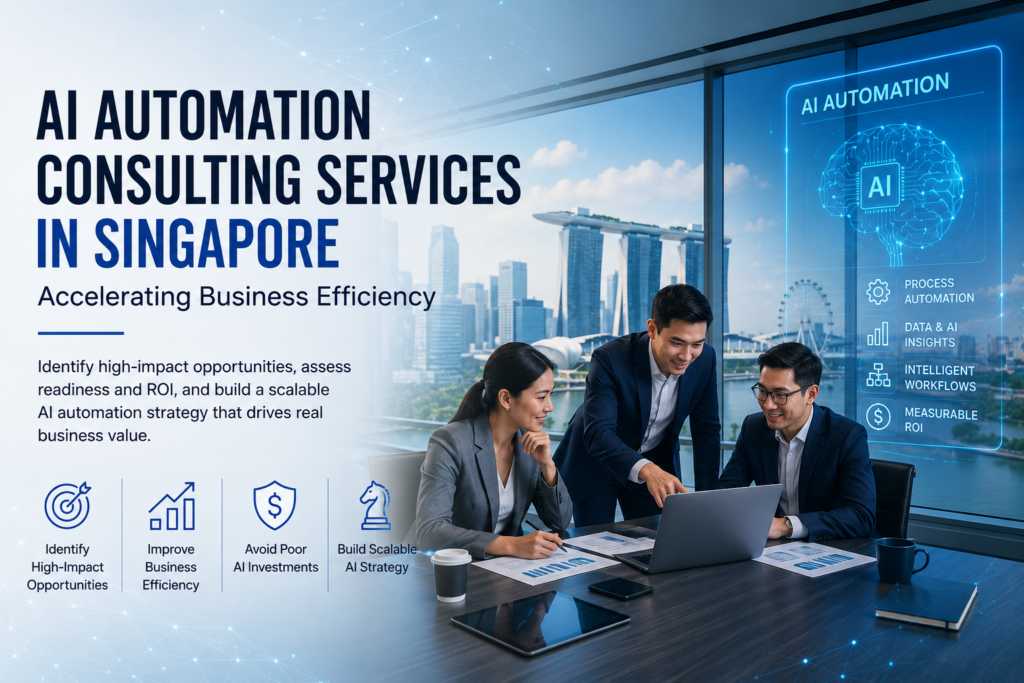
AI Automation Consulting Services in Singapore
Artificial intelligence is becoming an increasingly viable solution for businesses seeking to improve efficiency, reduce repetitive tasks, enhance the customer experience, and optimise the use of data.
Across financial services, logistics, manufacturing, healthcare, technology, and professional services, organisations are looking to leverage AI automation to drive productivity, scale operations, and improve customer experiences.
However, adopting AI automation is not as simple as purchasing new software. Businesses must understand which processes should be automated, where AI can create the most value, whether their systems and data are ready, and how automation fits into their broader business strategy.
This is where AI Automation Consulting can help.
AI Automation Consulting provides businesses with the insights required to identify automation opportunities, understand the potential impact and ROI, assess implementation feasibility, and develop an actionable roadmap.
At Axiora Labs AI, we help organisations in Singapore capitalise on AI automation opportunities that unlock value and drive efficiency, productivity, and scalability.
What Is AI Automation Consulting?
AI Automation Consulting helps organisations identify, assess, and capitalise on automation opportunities enabled by artificial intelligence.
Rather than focusing on specific technologies, AI Automation Consultants take a strategic view of an organisation’s processes, systems, data, and objectives to determine where automation can create the most value.
The areas under consideration can include:
- Administrative processes
- Customer support
- Sales
- Marketing
- Finance
- Human resources
- Document processing
- Internal reporting
- Data management
- Supply chain
- Knowledge management
- Software and system integration
Each of these areas can be assessed in terms of potential business impact, technical feasibility, data readiness, implementation complexity, risks, and ROI.
The focus is on understanding where automation can create the most value.
Why Singapore Businesses Need AI Automation Consulting
Businesses in Singapore often operate in highly competitive and interconnected environments where efficiency, customer experience, speed, and scalability are critical.
AI automation can play a pivotal role in supporting these objectives, but the wrong approaches can lead to fragmented implementations, poor ROI, and missed opportunities.
Identify High-Impact AI Automation Opportunities
Most organisations have numerous processes that could benefit from automation. However, not all of these processes offer the same potential value, and businesses must prioritise based on factors such as volume, impact, and implementation complexity.
Processes that are strong candidates for automation often involve:
- High transaction or data volumes
- A high degree of repetition or standardisation
- Significant manual effort
- Large amounts of information or data
- Predictability and consistency
- Long processing times
- Multiple steps and handoffs
- A high risk of error
- Repetitive decision-making
- Administrative or support-related activities
An AI Automation Consultant can help organisations identify the opportunities that offer the most value and are the simplest to implement.
Improve Business Efficiency
AI automation can reduce the amount of time spent on repetitive, manual, or information-intensive tasks.
This can include:
- Data entry
- Document processing
- Reporting and analytics
- Customer information searches
- Classification and tagging
- Sales follow-ups and reminders
- Internal approvals
- Repetitive analysis
By reducing the time spent on these activities, businesses can create capacity while reducing costs and errors.
Avoid Poor AI Investments
The market for AI-driven automation tools and technologies is highly competitive and offers organisations with an extensive range of options.
However, investing in the wrong tools or approaches can waste resources and fail to deliver value.
Common pitfalls include:
- Buying tools that are not used or needed
- Acquiring technologies that offer limited benefits over existing solutions
- Failing to consider compatibility and integration
- Automating the wrong processes
- Making investments before understanding data requirements
- Overlooking governance, security, and compliance requirements
- Failing to identify responsible AI ownership
AI Automation Consulting helps organisations avoid these pitfalls by focusing on opportunities before selecting the most suitable tools and approaches.
Build a Scalable AI Automation Strategy
Businesses do not need to automate every process at once.
A well-defined AI automation strategy can help organisations capitalise on the most valuable opportunities while managing implementation complexity and costs.
This can include identifying:
- Quick wins – opportunities with the highest potential value and the simplest implementation.
- Strategic initiatives – larger-scale projects that provide significant benefits.
- Long-term opportunities – projects that require more time, data preparation, and system upgrades but offer substantial benefits.
This phased approach can help organisations realise value sooner while continuing to refine their automation strategy.
What Can AI Automation Consultants Help Singapore Businesses Automate?
AI automation can be applied to a broad range of processes and functions.
The following areas are common across most industries and often benefit from AI-driven automation:
Operations
Operational processes often involve significant amounts of repetitive tasks, approvals, information exchange, and reporting.
These can include:
- Workflow routing
- Data synchronisation
- Internal approvals
- Report generation
- Document processing
- Operational reporting
- Monitoring and exception detection
- Automated notifications
By automating these processes, businesses can reduce the risk of errors, delays, and inconsistencies.
Customer Support
Customer service processes often include repetitive tasks and information searches.
These can be automated using:
- AI chatbots
- Ticket categorisation
- Routing and escalation
- Knowledge-base searches
- Summary generation
- Conversation analysis
- Sentiment analysis
- Support agent copilots
While automating customer support processes can reduce the workload for employees, it is essential to recognise that most customers still require human interaction and assistance.
Sales
Many sales processes and activities are repetitive and do not require significant decision-making.
These include:
- Lead qualification
- CRM updates
- Account research
- Email personalisation
- Meeting summaries
- Follow-up automation
- Lead scoring
- Proposal generation
- Pipeline analysis
By reducing the time spent on these activities, sales teams can focus more on selling and building relationships.
Marketing
Marketing processes and activities often require extensive use of data, information, and content.
These include:
- Content production and management
- Marketing analytics
- Audience segmentation
- Campaign reporting
- Lead enrichment
- Personalisation
- Market research
- Performance analysis
- Content repurposing
Marketing automation can help businesses reduce the time spent on repetitive, data-heavy activities while supporting more strategic uses of data and content.
Human Resources
Many HR processes and activities are repetitive and involve significant amounts of documentation.
These include:
- Employee onboarding
- Candidate screening
- Interview scheduling
- HR knowledge assistants
- Employee request management
- Document processing
- Policy searches
While many of these activities can be automated, organisations must ensure that fairness, privacy, and transparency are built into the design.
Finance
Finance processes and activities often involve large amounts of data and repetitive document processing.
These include:
- Invoice processing
- Expense categorisation
- Financial document extraction
- Reconciliation support
- Data validation
- Accounts payable automation
- Report generation
- Financial analysis
By automating these processes, finance teams can reduce the time spent on repetitive activities while improving accuracy and reducing errors.
Supply Chain
Singapore’s role as a regional logistics and distribution hub creates numerous automation opportunities for businesses.
These include:
- Demand planning
- Inventory analysis
- Shipment tracking
- Supplier document processing
- Logistics automation
- Procurement assistance
- Exception detection
- Operational reporting
- Supply chain analytics
The potential opportunities will depend on the data available and the systems in use.
Our AI Automation Consulting Process
At axioralabs.ai, our approach to AI automation consulting combines business analysis, technical assessment, and implementation planning to help organisations capitalise on the most valuable opportunities.
1. Discovery Workshop
The first step in our AI automation consulting process is the discovery workshop. This session is used to understand the business, its objectives, and its requirements.
The following areas are typically reviewed:
- Business and operational goals
- Challenges and pain points
- Current technology and automation
- Department-specific requirements
- Growth priorities
- Existing AI initiatives
This information is used to establish the areas where AI automation can create the most value.
2. Business Process Analysis
The next step is to review business processes to identify areas of opportunity.
The focus is on understanding how work is currently being done, including:
- Manual processes
- Repetitive activities
- Information exchanges
- Approvals
- High-volume operations
- Delays and bottlenecks
- Error sources
- Decision points
This information is used to build an understanding of the processes and identify areas of opportunity.
3. AI Automation Assessment
An AI Automation Assessment can be conducted as a stand-alone engagement or as part of a broader consulting initiative.
This assessment provides an overview of the business workflows, systems, data, and opportunities to help organisations understand what can be automated and the potential impact.
The assessment typically includes:
- Analysis of business processes
- Technical and integration requirements
- Data readiness and availability
- Security and compliance requirements
- Organisational requirements and readiness
- Potential business value and ROI
This information is used to establish the most viable opportunities.
4. AI Opportunity Identification
Once the business environment has been understood, potential AI automation opportunities can be identified and prioritised.
This involves linking business requirements to potential technologies, including:
- Generative AI
- AI agents
- Document processing
- Workflow automation
- Predictive analytics
- Machine learning
- Natural language processing
- Internal AI assistants
- Customer-facing assistants
- Automated analytics
Each of these capabilities can be applied to different business processes to deliver specific benefits.
5. ROI Assessment
AI automation initiatives should be designed to deliver measurable business benefits.
The potential value of different opportunities can be assessed using criteria such as:
- Time saved by employees
- Reduction in processing time
- Cost savings
- Error reduction
- Capacity improvements
- Productivity gains
- Enhanced customer experience
- Implementation costs
This information can be used to compare different opportunities and focus on those that offer the highest value.
6. AI Readiness Evaluation
Many organisations fail to realise the benefits of AI automation because they are unable to implement the chosen solution.
This can happen when opportunities are prioritised without considering organisational readiness.
This assessment typically covers the following areas:
- Data availability and quality
- Applications and systems
- APIs and integrations
- Cloud infrastructure
- Security requirements
- Governance requirements
- Internal capabilities
- Change management requirements
By identifying these factors, organisations can understand the risks and challenges associated with different opportunities.
7. AI Automation Roadmap Development
The final step in our AI automation consulting process is the development of an AI automation roadmap.
This roadmap serves as a reference that guides organisations through the implementation of AI automation.
The roadmap typically includes:
- Overview of automation opportunities
- Quick wins and strategic initiatives
- Technology requirements
- Integration requirements
- Dependencies
- Potential business impact
- Pilot opportunities
- Scaling considerations
This provides organisations with a clear view of the next steps.
How Should AI Automation Opportunities Be Prioritised?
Opportunities for AI automation can be identified across most businesses and industries. However, organisations must ensure that they are prioritising the most valuable opportunities.
The following factors should be considered when prioritising AI automation opportunities:
Business Impact
The potential business impact of an automation opportunity can take many forms, including:
- Cost reduction
- Productivity improvements
- Increased processing speeds
- Higher operational capacity
- Improved customer experiences
- Reduction in employee effort
- Revenue improvements
Opportunities that offer the highest potential impact should be prioritised, as they will provide more value for the organisation.
AI Automation Feasibility
Some processes and activities are much easier to automate than others.
Most automation opportunities will fall into one of the following categories:
- Straightforward: These opportunities involve simple, repeatable activities with clear inputs and outputs.
- Moderate: These opportunities require additional steps or preparation before automation can occur.
- Complex: These opportunities often require extensive redesign before they can be automated.
Opportunities that fall into the “straightforward” category should be prioritised.
Data Readiness
Most AI automation opportunities require access to data.
Organisations must understand their data requirements and consider the following factors:
- Do they have access to the data?
- Where is the data stored?
- Is the data accurate?
- Can the data be accessed?
- Can the data be used securely?
These factors must be considered when prioritising automation opportunities.
Implementation Complexity
Some automation initiatives can be implemented using existing technologies and tools.
However, more complex opportunities may require additional steps, including:
- Custom development
- Data preparation
- New integrations
- Cloud infrastructure
- Process redesign
- System upgrades
These factors must be weighed against the potential benefits when prioritising automation opportunities.
Security, Privacy, and Governance
Organisations must also consider the following factors when prioritising automation opportunities:
- Data privacy and security
- Information security requirements
- Human oversight requirements
- Accuracy and reliability of AI
- Internal governance requirements
- AI auditability and transparency
- Responsible AI requirements
- Regulatory requirements
These factors should be considered when developing an AI automation roadmap.
Industries We Serve With AI Automation Consulting in Singapore
We offer AI automation consulting to organisations across most industries, including the following:
Logistics & Supply Chain
We can help logistics and supply chain organisations identify numerous automation opportunities, including shipment tracking, forecasting, inventory analysis, logistics documentation processing, procurement assistance, and supply chain analytics.
Banking & Financial Services
Financial services organisations can benefit from AI automation in a wide range of areas, including document processing, customer operations, financial analysis, reporting, internal operations, and knowledge management.
Insurance
Insurance companies can benefit from AI automation in claims processing, policy administration, customer operations, document processing, data extraction, and analytics.
Manufacturing
Manufacturing organisations can use AI automation in a wide range of areas, including production, quality control, predictive maintenance, supply chain operations, reporting, and analytics.
Healthcare
Healthcare providers can benefit from AI automation in administrative operations, documentation, scheduling, information management, and other areas to improve efficiency while maintaining patient privacy and governance.
Pharma & Life Sciences
Pharma and life sciences companies can benefit from AI automation in research, documentation, data processing, knowledge management, and reporting.
Enterprise IT & Regional Operations
Large enterprises can benefit from AI automation in IT operations, employee services, enterprise search, knowledge management, workflow automation, and data analytics.
Legal & Professional Services
Legal and professional service firms can benefit from AI automation in document review, contract lifecycle management, research, knowledge management, and administrative operations.
What You Receive From AI Automation Consulting
Depending on the scope of the engagement, our AI automation consulting services can include the following deliverables:
- Business process analysis
- AI Automation Assessment
- Automation opportunity mapping
- Prioritised AI use cases
- AI readiness evaluation
- Technology recommendations
- Integration considerations
- ROI analysis
- Risk and dependency assessment
- Quick-win identification
- Implementation roadmap
- Pilot recommendations
- Next-step planning
These deliverables help organisations understand their automation opportunities and realise value from AI automation.
Why Choose Axiora Labs AI for AI Automation Consulting in Singapore?
Most businesses understand the need to incorporate new technologies into their operations. However, many fail to invest in the right technologies or overlook the opportunities available to them.
At Axiora Labs AI, we take a strategic approach to AI automation that helps organisations identify the most valuable opportunities.
Our consulting approach combines:
- Business process analysis
- AI Automation Assessment
- AI opportunity discovery
- Technical feasibility analysis
- AI readiness evaluation
- ROI-focused prioritisation
- Automation strategy
- Implementation planning
- AI roadmap development
Our goal is to help organisations capitalise on the most valuable automation opportunities and realise measurable business benefits.
From AI Automation to Greater Business Efficiency
AI automation can be used to improve efficiency, reduce costs, and create new opportunities for growth.
However, most businesses do not have the resources to embark on a large-scale AI transformation.
As such, the most viable starting point is usually the identification of a few high-impact, low-complexity processes that can be automated.
These could include:
- Document processing
- Customer support categorisation
- Internal reporting
- Sales administration
- Employee knowledge searches
- Finance operations
- Data entry
Once these processes have been automated and have delivered value, businesses can invest in additional automation opportunities.
This phased approach can help organisations realise value from AI automation without incurring significant costs or implementation complexity.
Start Your AI Automation Consulting Journey
Most businesses are sitting on numerous opportunities for AI automation that could help them reduce costs, improve productivity, and create new revenue streams.
The challenge is usually one of prioritisation, as most organisations do not have the resources to pursue all automation opportunities at once.
Axiora Labs AI helps organisations in Singapore identify the most valuable AI automation opportunities, assess implementation feasibility, understand potential ROI, and develop an actionable implementation roadmap.
Rather than pursuing disconnected automation initiatives, businesses can build a comprehensive AI strategy around their most viable opportunities.
Schedule an AI Automation Consulting session with Axiora Labs AI and discover how artificial intelligence can help you unlock new business efficiencies.
Learn more at axioralabs.ai.
Frequently Asked Questions
What Is AI Automation Consulting?
AI Automation Consulting helps organisations identify, assess, and capitalise on automation opportunities enabled by artificial intelligence.
How Can AI Automation Consulting Improve Business Efficiency?
It helps identify repetitive, high-volume, time-consuming, or information-intensive workflows that can be automated to reduce manual effort and improve processing speed.
What Does an AI Automation Consultant Do?
An AI Automation Consultant analyses processes, identifies automation opportunities, evaluates feasibility and readiness, estimates potential value, and develops implementation recommendations.
What Is an AI Automation Assessment?
An AI Automation Assessment evaluates an organisation’s processes, systems, data, and readiness to identify opportunities for automation that create measurable value.
Which Business Processes Are Best Suited to AI Automation?
Processes that are repetitive, high-volume, data-intensive, document-heavy, predictable, or time-consuming are typically strong candidates for automation.
Does AI Automation Consulting Include ROI Analysis?
A comprehensive engagement can include an assessment of potential time saved, productivity improvements, operating cost reductions, increased capacity, and implementation costs.
Is AI Automation Consulting Suitable for SMEs in Singapore?
Yes. Small and mid-sized businesses can benefit from a strategic approach that focuses on a limited number of high-impact opportunities.
What Happens After an AI Automation Consulting Engagement?
Businesses can use the roadmap to prioritise use cases, develop proofs of concept, launch pilot projects, measure performance, and scale successful initiatives.