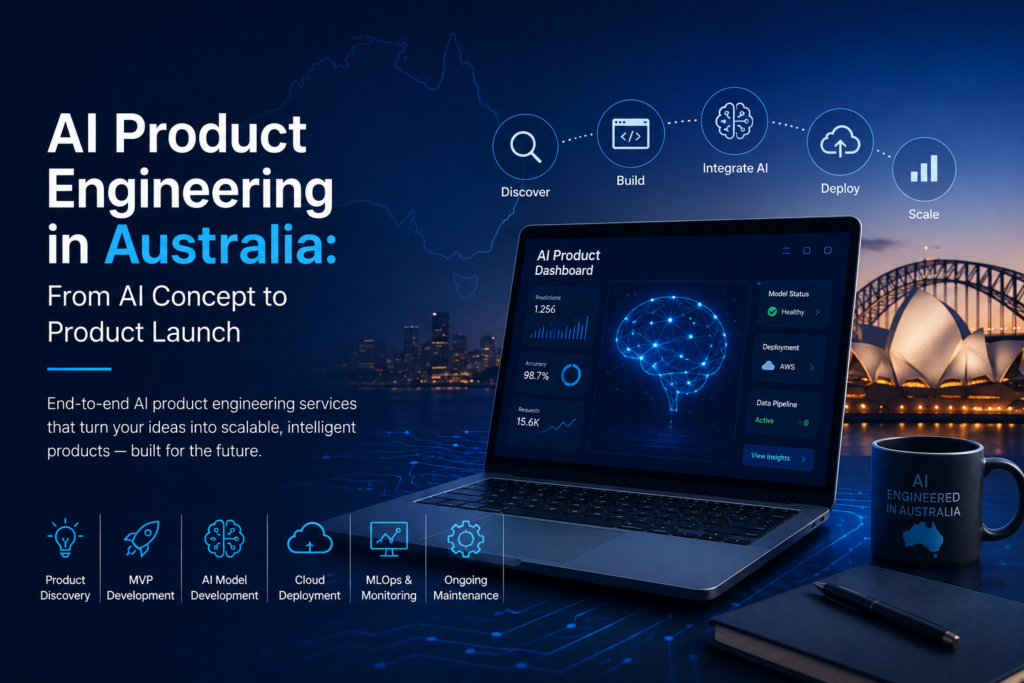
AI Product Engineering in Australia
Artificial intelligence is becoming an increasingly important component in the Australian
business landscape, from developing new products and automating operations to creating
novel experiences for their customers. From AI-driven SaaS and automation to predictive
analytics and generative AI, Australian businesses are starting to turn their proof of concepts
and experiments into reality and actual products.
Yet, for an Australian business, turning an idea and experiments with AI into a product and
service often involves more than just the selection of a particular model or the use of an API.
It requires product discovery, software engineering, AI development, infrastructure, testing,
deployment, and continuous improvement.
This is where AI product engineering comes in.
For Australian businesses, the right approach to AI product engineering can help design and
develop an actual product around a concept and prototype, taking care of business,
technical, and user requirements throughout the process.
What Is AI Product Engineering?
AI product engineering is the end-to-end process of designing, developing, testing, deploying,
and maintaining products that use artificial intelligence as a key enabler and differentiator.
The process covers a range of areas:
- Product discovery
- AI strategy
- MVP development
- Software engineering
- AI and ML
- Data engineering
- Product architecture
- Cloud deployment
- Testing and evaluation
- MLOps
- Product maintenance
The aim of AI product engineering is to produce an end product, which can be a stand-alone
AI product or an AI-enabled application. An AI product can come in many different forms,
such as predictive analytics, recommendation systems, generative AI assistants, computer
vision, AI automation, or an AI-driven SaaS application. Each of these products requires
different considerations in their development, but they all require much more than an AI
model.
For instance, an AI-powered customer assistant requires not only an AI model but also a UI,
back-end, authentication, databases, knowledge base, analytics, monitoring, security, and
cloud infrastructure, among others.
Why Are Australian Businesses Investing in AI Products?
Australian businesses are looking to embrace AI in a range of ways to automate their
operations, improve efficiency, and introduce novel experiences and services to their
customers. There are different ways in which Australian businesses can leverage AI, including
in the form of products and services.
Some common examples of AI products include:
- Generative AI assistants
- Intelligent customer assistants
- Document processing
- Predictive analytics
- Recommendation systems
- Automation of work and processes
- Computer vision
- Fraud detection
- AI SaaS
- Business intelligence
While some Australian businesses, particularly startups, may seek to develop an entirely new
product concept around an AI model, others, particularly more established firms, may seek to
integrate AI into their existing product offerings or applications. However, the question then
becomes what does it actually take to turn an AI concept into an actual product that can be
successfully delivered to the market?
AI Product Engineering Services for Australian Businesses
A comprehensive AI product engineering partner can help Australian businesses take their
idea from concept through to MVP and to actual product launch and beyond. Here are the
key elements that go into AI product engineering:
Product Discovery
The first step in engineering an AI product is to discover and design a product that will be
valuable to the business and its customers and which is realistic and viable to build.
This stage can involve:
- Requirement analysis
- User research
- AI use-case identification
- Feasibility analysis
- Competitor analysis
- Product roadmap design
- MVP planning
MVP Development
The development of an MVP is a crucial step for Australian businesses looking to launch an AI
product. An MVP lets the business test out an idea to see if it is viable and has value.
This stage can involve:
- AI-powered functionality
- Design and development of UI
- Development of back-end
- APIs development
- Authentication and security
- Database development
- Third-party integrations
- Analytics development
AI Model Development
Depending on the use case and requirements, an AI product may use a range of different
approaches and techniques, including:
- Generative AI
- Large language models
- Machine learning
- Natural language processing
- Computer vision
- Predictive analytics
- Recommendation systems
- Classification
- Forecasting
While some AI products may require the development of a custom AI model, this is not
always the case, as there are also foundation models and APIs available that can be leveraged
for certain applications. Custom model development is typically required for AI products that
require bespoke approaches, data, or capabilities.
Product Architecture
The architecture design is a critical step in product development, as it defines what
technologies will be used to build the product.
An AI product typically involves:
- Application UI and back-end development
- AI model development
- APIs development
- Database development
- Data pipeline development
- Vector database
- Cloud infrastructure
- Security and monitoring
The architecture should be designed in a way that makes it easy to add new users,
integrations, functionality, and models down the track.
Product Testing
Testing is an important part of any product engineering process, as it ensures the product
works and is fit for purpose. Testing an AI product involves both traditional software testing
and AI-specific testing and evaluation, including:
- Functionality testing
- API testing
- Performance testing
- Security testing
- Usability testing
- Testing at scale
- Model evaluation
- AI response testing
Testing of hallucination, response relevancy, consistency, response time, and other factors.
Cloud Deployment
The cloud infrastructure underpins any AI product, and the right infrastructure must be
selected based on the requirements of the product.
The cloud deployment process can involve:
- Cloud computing
- GPU infrastructure
- Containerization
- Databases
- Storage
- APIs
- CI/CD
- Monitoring
- Infrastructure security
MLOps
MLOps makes it possible to manage, monitor, deploy, and maintain AI models in production.
By implementing the right MLOps practices and infrastructure, an Australian business can
ensure that its AI products remain performant and continue delivering value after launch.
Product Maintenance
Once an AI product is launched, it requires continued maintenance and improvement.
This can involve:
- Bug fixing
- Security and compliance
- AI model improvement and maintenance
- Performance and infrastructure optimization
- Feature enhancement
- AI evaluation
- Cost optimization
- Technical support
Our AI Product Development Process
Understand the Business Problem
This step involves understanding the business challenge that needs to be addressed, who the
target users are, what they want and need, what solutions have already been explored, what
technologies have been considered or are in use, and how AI fits into the overall solution.
Define the Product Strategy
At this stage, the product scope, key features, and capabilities are defined, along with the
technical requirements and approach based on the identified requirements. Part of this step
also includes planning the MVP development and the roadmap for the product.
Design the Product Architecture
Based on the product strategy and requirements, the overall application architecture is
designed, including the key elements and components such as AI models, APIs, databases, UI,
and security infrastructure.
Build the MVP
Building the MVP involves developing the most valuable elements and features of the
product, which allows validating the concept and exploring possible ideas without investing
too much time and effort into a product that may not be viable.
Develop and Integrate AI
Depending on the requirements and strategy, the relevant AI elements are then developed
and integrated into the product, potentially including models, APIs, retrieval systems,
computer vision, and other AI components.
Test and Evaluate
The product is then tested and evaluated for its overall fitness for purpose, including testing
of its features, performance, security, usability, and other aspects.
Deploy to the Cloud
Once the product has been validated, it can be deployed to the cloud using the relevant
infrastructure and tools, taking care to ensure that everything is secure and reliable.
Optimize and Scale
Once the product has been launched and deployed, it can then be further optimized based
on user feedback and product analytics, potentially adding new features and improving
performance and infrastructure.
Technologies Used for AI Product Engineering
The technologies and tools used in AI product engineering can vary greatly depending on the
specific requirements and approaches of a given project. Some of the main technologies and
tools involved in AI product engineering include:
AI and Machine Learning
- Python
- PyTorch
- TensorFlow
- Scikit-learn
- Generative AI
- Large language models
- Natural language processing
- Computer vision
Backend Development
- Python
- Node.js
- REST APIs
- GraphQL
- Microservices
- Serverless
Frontend Development
- React
- Next.js
- Typescript
- Modern web frameworks
Data Technologies
- PostgreSQL
- MongoDB
- Redis
- Vector databases
- Data warehouses
- Data processing
Cloud and Infrastructure
- AWS
- Microsoft Azure
- Google Cloud
- Docker
- Kubernetes
- CI/CD
- Infrastructure automation
MLOps and Monitoring
- Model versioning
- Model monitoring
- Experiment tracking
- Automated model deployment
- AI evaluation
- Application observability
The above is a general list of technologies that may be used in a given AI product engineering
project, but the specific technologies and stacks will be determined based on the requirements
and strategy of a given project. In particular, when building an AI product, it is important to
choose the right technologies, rather than use an off-the-shelf solution.
Industries We Build AI Products For
Healthcare
Healthcare administration, documentation, analytics, and AI-enabled processes
Financial Services
Fraud detection, analytics, customer assistants, and AI-enabled document processing
Retail and E-commerce
Recommendations, personalization, demand forecasting, and intelligent customer assistants
Mining and Resources
Predictive maintenance, monitoring, analytics, and safety solutions
Logistics and Transportation
Route optimization, demand forecasting, and logistics planning
Manufacturing
Quality inspection, predictive maintenance, computer vision, and process optimization
Real Estate
Property recommendations, document analysis, analytics, and lead management
SaaS and Technology
Enterprise copilots, search platforms, automation, and AI assistants
Why Choose AxioraLabs AI for AI Product Engineering?
While many Australian businesses understand the need for AI and what they want to use it
for, there are often few that actually know how to turn an idea and a prototype into an actual
product. At AxioraLabs AI, we can help Australian businesses build reliable, high-quality AI
products that actually perform and deliver value.
When it comes to building products, we believe in an end-to-end approach that focuses on
the needs of the business, the capabilities of the technology, and the requirements of the
users. Our approach to AI product engineering has several advantages:
- End-to-end product engineering: From product discovery and MVP development to deployment and maintenance.
- Business-centric AI: We focus on the business needs and use cases when designing products.
- Scalable architecture: We design products with future requirements in mind.
- Production-ready engineering: Our focus on reliability and performance makes sure products are fit for purpose.
- Flexible technology stacks: We use a variety of technologies and tools based on the requirements of a given project.
- Continuous optimization: We work to continuously improve products based on user feedback and performance metrics.
Whether you are an Australian-based start-up with an innovative idea that you want to bring
to life or an established business looking to enhance your existing products with AI, the right
product engineering partner can help you realize the value of your concept and deliver an AI
product that performs.
FAQs About AI Product Engineering in Australia
How Much Does AI Product Engineering Cost in Australia?
The cost of AI Product Engineering will depend on a range of factors, including the complexity of the product, the
required AI capabilities, the level of integration with other systems and data sources, the
team size, and the duration of the project, among others. Compared to enterprise-level
products, an MVP will typically be significantly cheaper and quicker to develop.
How Long Does It Take to Build an AI Product in Australia?
The timeline for developing an AI product will vary depending on the complexity and scope of
the product. As a rule of thumb, an MVP can take anywhere from a few weeks to a few months
to develop, while enterprise-level products will take longer to develop.
Should Australian Businesses Build an AI Model From Scratch?
You should not always build an AI model from scratch, as there are established foundation
models and APIs that can be leveraged for many applications. Building from scratch should be
considered when bespoke approaches, data, or processing capabilities are required.
Can AI Be Integrated Into an Existing Software Product?
Yes, AI can be integrated into an existing application or software product, whether it is a SaaS
application, enterprise-level software, a website, or another type of software.
What Is the Difference Between AI Development and AI Product Engineering?
AI development encompasses a range of activities related to the creation of AI systems, while
AI product engineering refers to the entire process of developing an end-to-end product that
incorporates AI elements and capabilities.
Why Is MLOps Important for AI Products?
MLOps enable effective management, deployment, and maintenance of AI models in
production, which becomes critically important as products grow and require additional
models.
Can AI Products Be Built for Australian Businesses With Local Data Requirements?
Yes, local data requirements can be taken into consideration when designing an AI product,
including differences in data infrastructures, security, and privacy requirements. This should
be considered during the architecture and product discovery phases, rather than after the
product has been built.