AI Product Engineering in the UK
Artificial intelligence presents a great opportunity for businesses in the UK to innovate and differentiate themselves in the market. From SaaS products and automation to predictive analytics and generative AI use cases, companies are looking to design and develop functional AI products.
However, building an AI product is more than just implementing a model or an API. It requires product strategy, software engineering, AI development, cloud infrastructure, testing, deployment, and ongoing maintenance.
What Is AI Product Engineering?
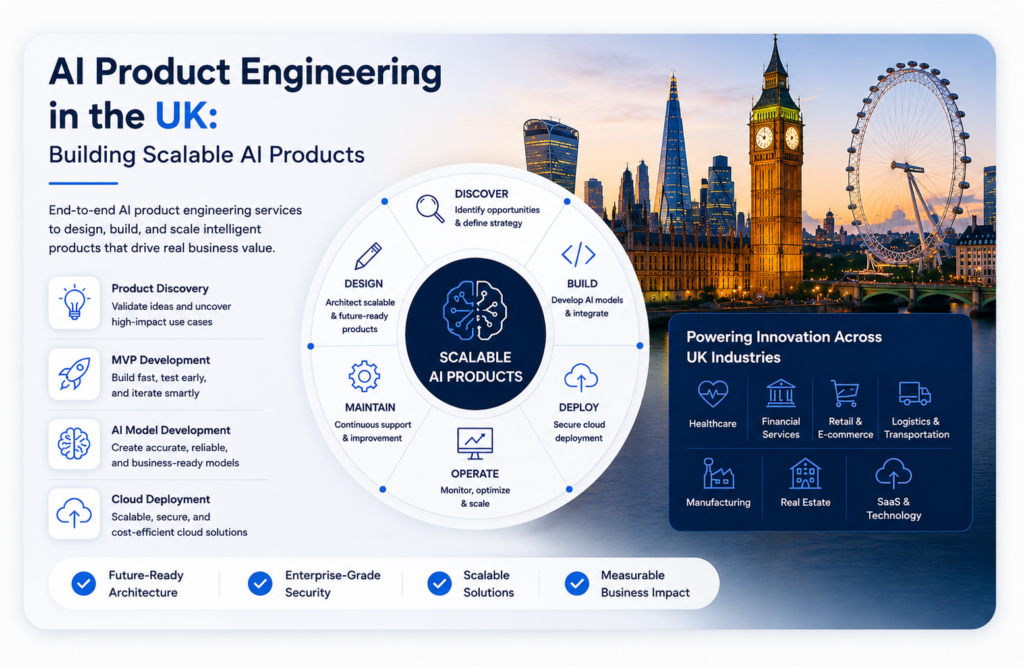
AI product engineering refers to the end-to-end product development cycle that incorporates artificial intelligence. It combines product engineering with AI development, covering product discovery, design, development, testing, launch, and ongoing maintenance.
Key Areas of AI Product Engineering
- Product discovery
- UX and product design
- Software development
- AI and ML development
- Data engineering
- Cloud infrastructure
- Model integration
- MLOps
- Testing
- Product maintenance
Why Are UK Businesses Investing in AI Products?
AI is becoming an important part of digital transformation in the UK. Businesses are using AI products to automate repetitive processes, improve customer experiences, analyze data, and enhance existing products and services.
Common AI Product Applications
- Generative AI
- SaaS products with embedded AI
- Document processing
- Predictive analytics
- Recommendation systems
- Customer service automation
- Computer vision
- Fraud detection
- Workflow automation
- Business intelligence
AI Product Engineering Services for UK Businesses
An end-to-end AI product engineering approach can support businesses throughout the complete product lifecycle, from initial discovery to maintenance and optimization.
Product Discovery
Product discovery helps businesses identify product needs, define requirements, assess technical and commercial viability, and determine the most valuable AI opportunities.
MVP Development
An MVP allows businesses to validate their product idea with real users while reducing development risks and accelerating time-to-market.
AI Model Development
Depending on the product requirements, AI capabilities may include generative AI, natural language processing, machine learning, computer vision, predictive analytics, recommendation systems, classification, and forecasting.
Product Architecture
A scalable product architecture can include frontend and backend systems, AI and ML models, APIs, databases, data pipelines, vector databases, cloud infrastructure, authentication, security, logging, and monitoring.
Product Testing
Comprehensive testing helps ensure product quality, security, performance, usability, scalability, responsiveness, and AI model reliability.
Cloud Deployment
Cloud infrastructure supports the performance, scalability, stability, and security of modern AI products. Deployment may include computing, GPU infrastructure, containers, databases, storage, APIs, CI/CD, monitoring, and security.
MLOps
MLOps helps standardize AI model development and maintenance through version control, model monitoring, retraining, experiment tracking, CI/CD, and automated deployment.
Product Maintenance
Ongoing maintenance helps keep AI products secure, reliable, optimized, and aligned with changing business requirements.
Our AI Product Development Process
Understand the Business Problem
We begin by understanding the business problem, target users, existing solutions, desired outcomes, and potential AI opportunities.
Define the Product Strategy
The product strategy defines requirements, core features, AI capabilities, MVP scope, technical requirements, and the development roadmap.
Design the Product Architecture
We design the application components, AI elements, data pipelines, integrations, infrastructure, security, and other technical requirements.
Build the MVP
The MVP focuses on the highest-value features and helps validate the product concept before moving toward larger-scale development.
Develop and Integrate AI
AI models, APIs, retrieval systems, machine learning pipelines, and other intelligent components can be developed and integrated based on the product requirements.
Test and Evaluate
The product is tested for functionality, performance, security, usability, reliability, scalability, and AI quality.
Deploy to the Cloud
Once the product has been validated, it can be deployed to production-ready cloud infrastructure.
Optimize and Scale
After launch, the product can be continuously improved and scaled using user feedback, analytics, and evolving business requirements.
Technologies Behind AI Product Engineering
AI and Machine Learning Technologies
- Python
- PyTorch
- TensorFlow
- Scikit-learn
- Natural Language Processing
- Computer Vision
- Generative AI
- Foundation Models
Backend Technologies
- Python
- Node.js
- REST APIs
- GraphQL
- Microservices
- Serverless architectures
Frontend Technologies
- React
- Next.js
- TypeScript
- Modern web application frameworks
Data Technologies
- PostgreSQL
- MongoDB
- Redis
- Vector databases
- Data warehouses
- Data processing pipelines
Cloud Technologies
- AWS
- Microsoft Azure
- Google Cloud
- Docker
- Kubernetes
- CI/CD
MLOps Technologies
- Model versioning
- Model monitoring
- Experiment tracking
- Automated deployment
- AI evaluation
- Application observability
Industries We Build AI Products For
Healthcare
AI can support healthcare documentation, patient engagement, administrative automation, and analytical insights.
Financial Services
AI can support fraud detection, customer service, document processing, analytics, and risk assessment.
Retail
AI can power recommendation systems, personalized experiences, pricing optimization, smart logistics, and more.
Logistics
AI can support demand planning, route optimization, and fleet management.
Manufacturing
Manufacturers can use AI-powered inspection systems, computer vision, and predictive maintenance.
Real Estate
AI can improve lead generation, property data analysis, and customer communication.
SaaS and Technology
Technology companies can build intelligent products such as copilots, search APIs, and automation tools.
Why Choose AxioraLabs AI for AI Product Engineering?
End-to-End Development
We can manage all aspects of product engineering, from discovery and MVP development to maintenance and ongoing optimization.
Business-Driven Approach
We design AI products around business objectives while combining essential AI capabilities with the wider product requirements.
Scalable Architecture
We aim to build products that are optimized for performance and designed to scale easily.
Production Readiness
We focus on reliability, security, performance, and thorough testing to ensure production-ready products.
Flexibility and Technology Choice
We select technologies based on the specific requirements of each project rather than relying on a fixed technology stack.
Continuous Improvement
We continuously optimize AI products based on user feedback, performance, and changing business requirements.
FAQs About AI Product Engineering in the UK
How Much Does AI Product Engineering Cost in the UK?
The cost of AI Product Engineering depends on product complexity, AI requirements, data integration, development team size, infrastructure, and other project-specific factors.
How Long Does It Take to Build an AI Product in the UK?
The timeline depends on the product scope and complexity. A realistic MVP can typically be developed within a few months.
Should a UK Business Build an AI Model From Scratch?
Not always. Existing AI models and APIs can provide sufficient functionality in many cases. Custom model development may be appropriate when specific functionality, accuracy, performance, or data privacy requirements demand it.
Can AI Be Integrated Into an Existing Software Product?
Yes. AI can be integrated into existing SaaS products and enterprise systems using APIs, existing models, or custom AI development.
What Is the Difference Between AI Development and AI Product Engineering?
AI development generally focuses on creating AI components, while AI product engineering covers the broader product lifecycle, including discovery, design, development, testing, deployment, and maintenance.
Why Is MLOps Important for Scalable AI Products?
MLOps supports model development, versioning, deployment, monitoring, and ongoing maintenance, helping AI products remain reliable as they scale.
Build Scalable AI Products With AxioraLabs AI
AI products can help businesses innovate, improve efficiency, and gain a competitive advantage. With the right product engineering approach, businesses can transform AI ideas into reliable, scalable, and production-ready products.