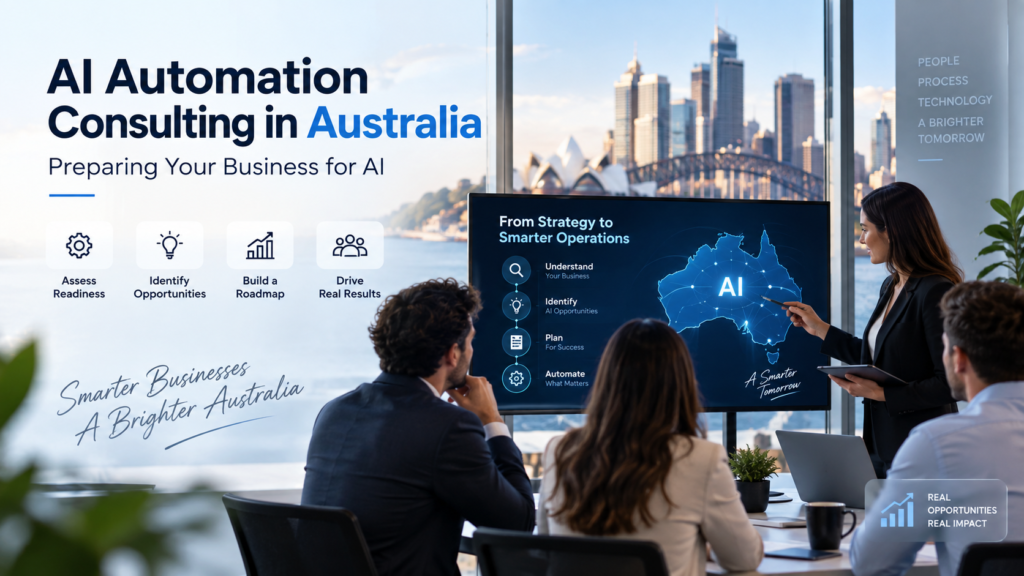
AI Automation Consulting in Australia
Artificial intelligence is increasingly integral to the functioning of Australian businesses, from customer service and information access to operations and productivity. Organisations are turning to AI agents, generative AI, intelligent automation, machine learning, and other technologies as a means of reducing drudgery and improving efficiency in the workplace.
However, businesses must also consider which processes can be automated, whether their systems and data can support AI, what resources they will have to devote to these technologies, and which opportunities will provide the best value.
That is why organisations need AI Automation Consulting. By understanding a business’s current state, automation opportunities, and requirements, AI Automation Consulting can help companies implement artificial intelligence strategically and realise its benefits.
Through AI Automation Consulting, Axiora Labs assist Australian businesses in identifying automation opportunities that align with their operations and drive value for their stakeholders.
What Is AI Automation Consulting?
AI Automation Consulting is a consultative discipline that helps organisations identify AI-related opportunities and determine where and how artificial intelligence and automation can be deployed within a business.
Rather than working from a given technology, consultants conduct an in-depth evaluation of the organisation, including its:
- Business processes
- Repetitive functions
- Customer service
- Sales
- Marketing
- Finance
- Human resources
- Document-heavy processes
- Supply chains
- Internal reporting
- Data
- Applications
- Software
- Other relevant areas
From there, potential automation opportunities can be identified and analysed, taking business impact, technical feasibility, data requirements, implementation, dependencies, risks, and ROI into account.
While the goal of automation is to reduce the burden on businesses, it should not be pursued indiscriminately. Rather, organisations should look at opportunities that make business sense.
Why Australian Businesses Need AI Automation Consulting
AI technologies are becoming increasingly accessible, making it easier for organisations to begin experimenting with automation and artificial intelligence. However, adopting these technologies without proper planning can lead to challenges.
AI Automation Consulting can help organisations realise the value of these technologies while minimising the risks.
Identify High-Impact AI Opportunities
Many businesses have numerous processes that could benefit from automation. The main challenge is often deciding which opportunities to pursue.
Processes that may benefit from AI automation usually have characteristics such as:
- High transaction volume
- Repetitiveness
- Manual effort
- Heavy data use
- Predictability
- Lengthy duration
- High error rates
- Extensive cross-functional coordination
- Repetitive decision-making
- High administrative burden
With that in mind, consultants can analyse a business’s processes and recommend opportunities for automating functions with the highest business impact and most implementation feasibility.
Prepare Your Business Before Implementing AI
Even the best-sounding opportunities can fail if a business is not in a position to support them. Organisations should identify their requirements and expectations before pursuing AI-related opportunities.
Such considerations may include:
- Data availability
- Data quality
- Software
- Technical infrastructure
- Security
- Cloud capabilities
- Internal competencies
- Governance
By fully understanding requirements, businesses can pursue technologies that meet their technical and operational needs.
Consultants can help organisations determine their requirements, ensuring that opportunities are viable before resources are devoted to their implementation.
Avoid Investing in the Wrong AI Tools
As businesses pursue automation, they often find themselves in the unfavourable position of having purchased solutions they neither needed nor wanted.
This may occur because organisations begin looking at technologies before thoroughly evaluating their requirements and opportunities.
Some of the issues that can arise include:
- Buying tools that employees are not interested in
- Purchasing technologies with overlapping capabilities
- Getting solutions that cannot integrate with existing systems
- Automating processes with limited value
- Buying tools before preparing data
- Implementing AI without considering ownership
- Failing to account for security, governance, and other critical factors
A consulting-driven approach can help organisations understand their requirements and opportunities first, ensuring that technology purchases contribute to business objectives.
It also allows businesses to avoid buying unnecessary solutions and prepares them for subsequent implementation.
Build a Realistic AI Automation Strategy
Adopting AI does not necessarily involve pursuing all opportunities at once. A realistic AI automation strategy enables organisations to capitalise on the most viable opportunities while postponing the ones that require significant resources or time.
A strategy can help businesses categorise opportunities, including quick wins, strategic initiatives, and long-term goals.
Quick wins often require minimal analysis, preparation, and resources but offer limited business value.
Strategic initiatives may have a shorter-term impact but can generate substantial value.
Long-term opportunities often require extensive preparation, including data and system upgrades, new governance policies, and organisational change, but can provide significant benefits.
Through AI Automation Consulting, businesses can work with consultants to build an automation roadmap that reflects their needs and objectives.
What Can AI Automation Consultants Help Australian Businesses Automate?
AI automation opportunities can emerge across various functions and departments, depending on an organisation’s operations, systems, and data.
Some common areas that can benefit from automation include operations, customer service, sales, marketing, human resources, finance, supply chains, and data-heavy processes.
Operations
Operations often involve a large number of repetitive processes that can benefit from automation.
Common opportunities include:
- Workflow coordination
- Data synchronisation
- Internal approvals
- Task allocation
- Report generation
- Document processing
- Operational dashboards
- Exception detection
- Notifications
- Process tracking
By implementing AI automation, organisations can reduce administrative workloads while standardising and accelerating their operations.
Customer Service
Customer service processes are often characterised by repetitive tasks and interactions.
Some common automation opportunities include:
- AI chatbots
- Ticket categorisation
- Intelligent routing
- Knowledge-base searches
- Response suggestions
- Conversation summarisation
- Sentiment analysis
- Agent copilots
- Follow-ups
In most cases, AI technologies should be viewed as tools to help human workers perform their tasks more efficiently.
Sales
Sales teams often have to perform numerous administrative tasks, ranging from lead qualification to email management.
Opportunities for automating sales processes include:
- Lead qualification
- CRM updates
- Account research
- Email personalisation
- Meeting summaries
- Follow-ups
- Lead scoring
- Proposal generation
- Pipeline analytics
- Sales forecasting
By reducing the time spent on administrative tasks, salespeople can dedicate more time to engaging prospects and closing deals.
Marketing
Marketing functions typically produce large volumes of data, information, content, and campaigns that can be automated.
Some marketing use cases include:
- Content pipelines
- Marketing analytics
- Customer segmentation
- Campaign reporting
- Lead enrichment
- Personalisation
- Market research
- Performance analysis
- Content repurposing
- Data analytics
By pursuing automation, organisations can improve marketing efficiency while minimising the administrative burden on their teams.
Consultants can assist businesses in identifying marketing processes that can be automated without compromising their strategic decision-making and creative capabilities.
Human Resources
HR departments typically handle numerous document-heavy, information-intensive, and repetitive processes.
Some HR automation opportunities include:
- Employee onboarding
- Candidate screening
- Interview scheduling
- HR knowledge base
- Employee requests
- Document scanning
- Policy lookups
- Internal support
- Employee communications
Wherever possible, organisations should ensure that their use of AI is fair, transparent, and accountable.
Finance
Finance operations often have highly structured but manual procedures that can be automated.
Some common opportunities include:
- Invoice processing
- Expense categorisation
- Financial document extraction
- Reconciliation support
- Data validation
- Account payables
- Report generation
- Financial analysis
- Managerial reporting
By implementing AI automation, organisations can reduce manual effort and streamline their financial operations.
Supply Chains
Australian organisations with supply chains, logistics, distribution, or manufacturing operations can benefit from automation opportunities.
Some common opportunities include:
- Demand planning
- Inventory analysis
- Shipment tracking
- Supplier documentation scanning
- Logistics processes
- Procurement
- Exception management
- Reporting
- Supplier communication
- Supply chain analytics
The viability of supply chain automation opportunities depends on the systems and data available to a business.
Our AI Automation Consulting Process
At axioralabs.ai, our consulting process is designed to help clients identify AI-related opportunities and move from theory to practice.
1. Discovery Workshop
The first step in our process is to understand the client’s requirements and expectations. The discovery session can cover a wide range of topics, including business goals, processes, systems, current automation, pain points, strategic objectives, and more.
2. Business Process Analysis
At this stage, consultants perform an in-depth analysis of the client’s business processes.
We identify repetitive, manual, information-intensive, approval-heavy, high-volume, slow, error-prone, and other processes that can benefit from automation.
3. AI Automation Assessment
An AI Automation Assessment can be conducted to understand the client’s processes, systems, data, applications, and technical environment.
This information can be used to determine which processes are the most viable for automation, what opportunities make the most business sense, what data will be necessary, what technical requirements exist, what risks and dependencies should be taken into account, and other factors.
4. AI Opportunity Identification
At this stage, we determine what AI capabilities can be used to address the client’s requirements.
Depending on an organisation’s needs, potential use cases can include:
- Generative AI
- AI agents
- Intelligent document processing
- Workflow automation
- Predictive analytics
- Natural language processing
- Machine learning
- Internal AI assistants
- Customer service AI assistants
- AI-driven analytics
- Knowledge assistants
- Decision-support solutions
Every opportunity should be aligned with specific business objectives.
5. ROI Assessment
Every AI initiative should be analysed in terms of the value it can provide.
Such considerations can include the reduction in employee hours, processing time, and operating costs, as well as the increase in capacity, productivity, and revenue.
By assessing the potential ROI of various opportunities, organisations can determine which initiatives to pursue.
6. AI Readiness Evaluation
Before implementing AI initiatives, organisations should evaluate their readiness.
This includes identifying what data, software, infrastructure, governance policies, cloud capabilities, security requirements, and other resources will be necessary.
By determining these requirements, businesses can prepare themselves for AI implementation and ensure they have the resources they need to pursue automation.
7. AI Automation Roadmap Development
The final stage involves developing an AI roadmap that aligns with the client’s strategic objectives.
The roadmap can include quick wins, strategic initiatives, and long-term opportunities, as well as a timeline and sequence of implementation.
By having a realistic roadmap in place, organisations can have a clear view of how they will adopt and implement AI solutions in the long run.
How Should AI Automation Opportunities Be Prioritised?
Now that you have understood which AI opportunities can be viable for your organisation, it is essential to determine which of them should be pursued.
Prioritisation typically involves analysing business impact and automation feasibility.
Other considerations can include data requirements, implementation complexity, and security, privacy, and governance requirements.
Business Impact
The first priority consideration should be the impact an automation opportunity can have on the business.
When analysing business impact, organisations should consider the value a given initiative can provide, what risks it can eliminate, and what opportunities it can create.
Some common factors to take into account include:
- Reduced operating costs
- Increased productivity
- Faster processing
- Higher capacity
- Improved customer experience
- Reduced employee workload
- New revenue opportunities
In most cases, initiatives that offer the highest value should be prioritised.
AI Automation Feasibility
Not every opportunity is feasible, and organisations should pursue the ones that cause the least disruption to their operations.
When determining automation feasibility, businesses should consider whether the target process is sufficiently reliable, consistent, structured, or repetitive to be automated.
Some processes may need to be redesigned to become viable for automation.
Data Requirements
Many AI initiatives require access to data, and organisations should determine whether they have the data they need and whether it is of sufficient quality.
Some data considerations include:
- Availability
- Accessibility
- Accuracy
- Applicability
- Whether additional data preparation is required
With that in mind, businesses should pursue opportunities that do not rely on unreliable data.
Implementation Complexity
Some automation opportunities can be implemented relatively quickly with little effort. By contrast, some opportunities may require extensive preparation, including system upgrades and data cleansing.
Organisations should consider how much effort will be required to prepare for and implement a given initiative.
Implementation complexity should be weighed against business impact, with the lowest complexity and highest impact opportunities typically being the most desirable.
Security, Privacy, and Governance
Many organisations will have to consider security, privacy, and governance requirements when pursuing AI opportunities.
Such considerations can include data privacy, information security, access controls, human oversight, AI accuracy, internal governance, auditability, responsible AI, and regulatory requirements.
Governance should be considered from the start of an AI initiative, rather than being an afterthought.
Industries We Serve With AI Automation Consulting in Australia
Australian organisations across a wide range of industries can benefit from AI automation opportunities. Some common areas we work with include logistics and supply chains, pharma and life sciences, enterprise IT and GCCs, manufacturing, banking and financial services, insurance, healthcare, legal services, government, and public sector.
Logistics & Supply Chains
Organisations in the logistics and supply chain space can benefit from automating various operations, including shipment tracking, inventory management, demand planning, logistics documentation scanning, supplier communication, procurement, exception management, and reporting.
Pharma & Life Sciences
Pharma and life sciences companies can explore a variety of AI opportunities, including research assistance, documentation scanning, data extraction, knowledge management, internal operations automation, and information retrieval.
Enterprise IT & GCCs
Enterprises and shared-service centres can benefit from exploring IT operations, knowledge management, employee support, workflow automation, enterprise search, data analytics, and productivity improvement.
Manufacturing
Manufacturing companies can capitalise on a variety of opportunities, including operation workflow automation, quality assurance, predictive maintenance, supply chain processes, documentation scanning, production reporting, and analytics.
Banking & Financial Services
Financial organisations can pursue a variety of AI automation opportunities, including document scanning, customer operations, financial analysis, internal operations, reporting, employee support, and knowledge management.
Insurance
Insurance companies can benefit from automating claims processing, policy administration, customer operations, document scanning, data extraction, analytics, and internal operations.
Healthcare
Healthcare organisations can consider a variety of opportunities, including administrative operations, documentation scanning, scheduling, information management, internal knowledge support, and analytics.
Whenever healthcare AI initiatives involve patient data, organisations must ensure that appropriate security, privacy, governance, and human oversight measures are in place.
Legal Services
Law firms and legal departments can explore numerous opportunities, including document scanning, contract automation, legal research assistance, knowledge management, and administrative operations automation.
Government & Public Sector
Government agencies can consider a variety of AI automation opportunities, including administrative operations, information management, documentation scanning, customer-facing processes, internal knowledge management, reporting, and employee support.
What You Receive From AI Automation Consulting
A competent AI Automation Consulting engagement should provide organisations with concrete recommendations on how they can capitalise on AI automation opportunities rather than simply listing them.
Depending on the scope and requirements of a project, deliverables may include:
- Business process analysis
- AI Automation Assessment
- Automation opportunity mapping
- Prioritised AI use cases
- AI readiness evaluation
- Technology recommendations
- Integration considerations
- ROI analysis
- Risk and dependency assessment
- Quick-win identification
- Strategic opportunity recommendations
- Implementation roadmap
- Pilot recommendations
- Next-step planning
Why Choose Axiora Labs AI for AI Automation Consulting in Australia?
AI Automation Consulting plays a critical role in helping organisations capitalise on the value of AI while minimising its risks. Many businesses, however, struggle to understand how artificial intelligence can be used to their advantage.
At Axiora Labs, we adopt an AI-powered business-first approach that enables us to guide our clients in pursuing realistic automation opportunities rather than getting caught in the frenzy of adopting the latest tools.
Our approach to AI Automation Consulting combines business process analysis, AI Automation Assessment, AI opportunity discovery, technical feasibility analysis, AI readiness evaluation, ROI-focused prioritisation, automation strategy, and implementation planning.
This allows organisations to understand how artificial intelligence can be applied within their specific spheres rather than trying to adopt every emerging innovation.
Preparing Your Business for Successful AI Adoption
Preparing your business for AI does not necessarily involve conducting widespread and disruptive changes to your operations. In fact, for most organisations, it is often wiser to begin with a few carefully selected automation opportunities.
Many businesses begin their AI journeys by automating document-heavy, high-volume, repetitive, and time-consuming processes.
Some common examples include invoice and expense processing, customer service ticket categorisation, internal reporting, sales administration, employee knowledge management, finance operations, and data entry.
After identifying and implementing quick wins, companies can take a step back to understand what works and what does not and refine their approach before pursuing more substantial opportunities.
AI Automation Consulting can help businesses adopt such a strategic approach to AI adoption.
Start Your AI Automation Consulting Journey
Your organisation likely has dozens of processes that could benefit from automation and realise significant efficiency gains.
The challenge, however, is choosing which opportunities are worth pursuing and ensuring your business can successfully adopt and implement them.
Axiora Labs AI Automation Consulting helps Australian businesses capitalise on automation opportunities, identify AI readiness requirements, evaluate potential ROI, and develop realistic implementation roadmaps that enable organisations to adopt AI strategically.
Rather than experimenting with disconnected technologies, organisations can identify the most viable automation use cases and pursue them systematically.
Schedule an AI Automation Consulting session with Axiora Labs AI and prepare your business for successful AI adoption and realisation of its business benefits.
Find out more at axioralabs.ai.
Frequently Asked Questions
What Is AI Automation Consulting?
AI Automation Consulting helps organisations identify and assess opportunities for applying artificial intelligence and automation to optimise business processes.
How Can AI Automation Consulting Help a Business Prepare for AI?
Consulting helps organisations understand their opportunities, requirements, and expectations, as well as analyse potential use cases and their impact, risks, and implementation considerations.
What Does an AI Automation Consultant Do?
An AI Automation Consultant helps an organisation review its processes to identify automation opportunities, assess their technical feasibility and business value, and develop opportunities for adoption.
What Is an AI Automation Assessment?
An AI Automation Assessment evaluates a business’s processes, systems, and data to identify opportunities for implementing AI-powered automation and realise its business benefits. The assessment can be a part of a larger consulting engagement.
Which Processes Are Best Suited to AI Automation?
Processes that have repetitive, high-volume, document-heavy, information-intensive, predictable, or time-consuming elements can often benefit from AI automation, but every opportunity must be reviewed on a case-by-case basis.
Does AI Automation Consulting Include ROI Analysis?
A comprehensive consulting engagement can include an analysis of potential cost savings, productivity gains, time reduction, capacity increases, implementation costs, and other factors to determine the ROI of different opportunities.
Is AI Automation Consulting Suitable for Australian SMEs?
Yes, because many small and medium-sized businesses can benefit from prioritising a limited number of high-impact opportunities rather than trying to adopt AI across their entire operations right away.
What Happens After an AI Automation Consulting Engagement?
After completing a consulting engagement, businesses can use the insights and recommendations to identify priorities, develop proof-of-concept projects, implement pilots, measure their impact, and scale opportunities.
How Do I Know if My Business Is Ready for AI?
A business’s readiness for AI is determined by various factors, including its data, systems, integration capabilities, security, governance, internal competencies, business processes, and organisational culture.
An AI readiness evaluation can help an organisation identify what it needs to pursue AI adoption and realise its benefits.